It’s time for the 35th edition of You Asked, The Gymternet Answered! We apologize if we haven’t gotten to your question yet, but we try to answer in the order in which they were received. Something you want to know? Ask us anonymously by going through the contact form at the bottom of the page.
What do you think about the PAC 12’s push to cut NCAA National’s down from 12 teams in semifinals to 8, and then from 6 in finals to 4? They claim this format will give Championships more success because it’ll be more likely to be on TV, which would give them a better following.
I actually love it, honestly. I hate the six team finals. Actually, the semifinals can be whatever. I’d even be open to like, 16 teams in four subdivisions where the top team from each gets a spot in finals. But the whole six team is terrible, not just because the format makes it hard to follow on TV, but because the rest of the season has no six-team meets so gymnasts aren’t used to having a ‘bye’ every two rotations, which really throws a wrench in a team’s momentum from event to event. Think about almost any other NCAA sport…how they play during the year is how they play in finals, so they can train for a finals situation, but with gymnastics the whole format is shuffled for their biggest meet of the year, which is really unfair and there’s no way to really train for it. I’d definitely be for at least changing finals to just four teams, even though it would suck to limit a team’s chance of making it to finals.
I’ve been a gymnastics fan since around 2008, and I know that in the past at Worlds and Olympics the qualification scores of gymnasts would carry over into finals. Which events did that affect (AA, EF’s, and/or TF), and when did that rule change? (I kind of like the concept because it would yield results which showed the gymnasts/teams who were the most consistent over two days of competition. For example, Viktoria Komova would have won the AA in 2012 had this rule been in effect.)
Qualifications stopped carrying over into finals in 1989, with the 1988 Olympic Games being the last major competition to see this rule in play. Called the “New Life” rule, scores would no longer carry over from qualifications to the final in an effort to allow gymnasts to start with a clean slate. Before the new life scoring system, final results were determined by the following:
- Team final*: team compulsories + team optionals
- All-around: team results (compulsories + optionals) averaged + all-around final
- Event finals: team results (compulsories + optionals) averaged + event final
* The team final acted as qualifications for AA and EF with no qualification into the team final. Every team or individual competed there, the team medals were awarded, and then individuals qualified on to the individual finals.
So you can’t really say “Komova would have won” because compulsories also played into someone’s AA score, and without compulsories happening in the current format, it’s impossible to say how Komova and Douglas would have scored comparatively there (and likewise, anything 1997 or later can’t really be compared using carry over rules because compulsories didn’t exist after that point making it impossible to tell). Getting rid of this format did affect Shannon Miller in 1992, however. Had the ‘new life’ rules not existed in 1992, she would have won.
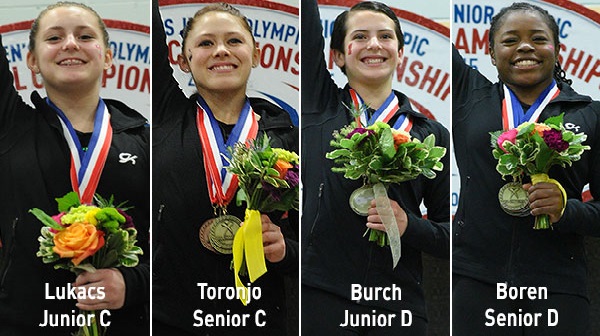
How do JO Nationals work? There are regions? There are A/B/C/D? Is there one overall winner?
There are eight regions in the country, with around 6 or so states in each. Gymnasts compete first at state championships, and then regional championships. Each region is allowed to qualify 56 gymnasts to nationals, with seven coming from each divisions.
The divisions are Junior A, B, C, and D (anyone born in 1999 or later is a junior this year) and then Senior A, B, C, and D (anyone born before 1999 this year). The A-D subdivisions are broken down by age, with Junior A being the youngest in the whole meet (some as young as 9) and Senior D being the oldest in the meet (usually the high school senior 18-year-olds in their last nationals before they go off to NCAA). The age divisions change each year depending on how many gymnasts of each age there are, and they’re broken down by birthday. This year, the breakdown was…
- Junior A – July 1, 2001 and later
- Junior B – June 1, 2000 to June 30, 2001
- Junior C – September 1, 1999 to May 31, 2000
- Junior D – January 1, 1999 to August 31, 1999
- Senior A – June 1, 1998 to December 31, 1998
- Senior B – November 1, 1997 to May 31, 1998
- Senior C – April 1, 1997 to October 31, 1997
- Senior D – March 31, 1997 and earlier
There is one winner per division, and no overall winner. Typically, even though everyone competing is a Level 10, the senior gymnasts are at an advantage in that they’re older and have trained longer, so if it was one overall winner, it would definitely skew toward the senior D gymnasts, who typically have the highest AA scores.
There is also a team component to JO nationals. Each region in each division competes as a team, with the top four scores counting for each. Some regions are known for generally dominating in the results…you’ll see a lot of region 1 (California area), 3 (Texas area), 5 (Michigan/Illinois area), and 8 (Southeastern USA area) wins, but 7 (NY / NJ / PA area) does a great job of holding their own and 4 (Minnesota area) had some great finishes this year as well.
I was re-watching the MAG Olympic vault finals for the past few cycles (because reasons), and I was just wondering if there have ever been any women who have competed the tsuk double? Is there some sort of devaluation of it for women (as has been proposed for the Produnova vault) so no one has worked on it? I feel like Simone at least could definitely get enough power for it, and it’d be nice to see some different vault entries in high level competition!
Several women compete the tsuk double! Or have competed it. Zamolodchikova was the first, back in 1999, and currently Mexico’s Alexa Moreno and China’s Wang Yan both compete it…possibly others, but these have done it most recently, with Wang Yan competing it at EFs at the Youth Olympic Games and Moreno competing it for most of the late 2014 season, including Pan Ams, Worlds, and prelims at the Central American & Caribbean Games. It’s ranked out of a 6.0 for women, but I think women tend to stray from the tsuk style vault in general (as well as the front handspring entry), instead working on the Yurchenko and Yurchenko half families.
If you’re referring to a tsuk double tuck and not a tsuk double twist, it could just be that it’s a very difficult vault, as the Produnova is. I can’t think of a woman ever competing a tsuk double tuck…I would imagine it would come with a good amount of difficulty, but because of the risks involved – i.e. rotating fully around and incurring either a deduction for a fall or just a straight up zero, or worse, getting injured – it might not be worth the difficulty. We also haven’t seen a Yurchenko double tuck from the women, and again I imagine it’s just that the rotation of two flips is so difficult, it probably just isn’t worth the potential injury or deduction.
Why is it that we don’t have a team final and AA final ‘every year’ at World and European Championships? I don’t understand the logic behind it. It’s only one more set of routines for the gymnasts to perform. They train everyday so surely it’s not something that would demand such an extra effort for them. It bugs me to have a championship without TF or AA finals.
Well, it is an extra effort not only for the gymnasts but for the national programs, especially in the year following the Olympics when most gymnasts are either taking breaks, considering retirement, or not training at their full capacity. The depth for teams in these ‘off’ years is far weaker than in average years, and I don’t think most nations would be able to field full teams, making a team final at a major competition really hard to manage. Like, even at the midway point in the quad in 2014, many teams found it difficult to put together full squads (notably Romania) so really, it’s not so much about adding one extra day of effort for the gymnasts but more about the programs trying to peak in the Olympic year and not really being in a position to field a full strong team every year until then.
What beam dismounts do college recruiters/coaches look for?
The modified code of points for NCAA beam is a minimum of a C dismount, or a B dismount preceded by any C element (acro or dance). So a C dismount would be a gainer full off the side, a front layout full, a back 1.5 and double full, a gainer pike off the end, and a tuck gainer full off the end. Those are the ones you see most often in NCAA, and if you really want to impress, then some D skills like a double back or a 2.5 have been done before at the collegiate level.
In NCAA, when a gymnast takes a fifth year because they were injured, do they still take classes even if they were on a track to graduate in four years? How do they plan for their fifth year in terms of their degree? Like when Sam P was a fourth year last year, she seemed like she was still contemplating taking her fifth year almost up to the very end, so does she just take even more classes in her fifth year even though her requirements have been completed for her degree? It’s just like another free year of class taking (if you’re on a full ride)?
If they were on track to graduate in four years, then they don’t need to take classes (though many gymnasts don’t graduate within four years and usually end up doing an extra semester or two just because it’s sometimes difficult to manage a full course load while training and competing). Like, Kayla Williams of Alabama is a good example because she didn’t redshirt or take a fifth year, but she actually graduated a year earlier than the usual four years because she’s a superstar, and so she just started taking classes toward her masters as she finished up her fourth and final year of eligibility.


Article by Lauren Hopkins
 The Gymternet
Chuso actually competed the Tsuk double in 2008 when she got the Olympic silver. I don’t think she’s done it all that many times before or since, but that one time she totally killed it! I think it’s not that popular though because it’s worth less than a Rudi, Amanar or Cheng so if you want to work Tsuk vaults you’d basically have to originate the 2.5 (on the women’s side) to have a really top score, whereas with the other entries you’d have more examples and stuff to work with.
LikeLike
Hi! This was actually my question, and I should have been more specific– I was wondering about the tsuk double tuck, not double full.
LikeLike
Oh, no worries!! Either way, we got you! 🙂
LikeLike
Simone wrote on her ask.fm that the two hardest vt she tried are Yurch double pike and TTY and she said that Yurch double pike is harder than TTY. What would the Yur double pike SV be? 7.0?
LikeLike
Probably higher…I don’t think we know yet what a Yurchenko double tuck is, though I think people had that around a 7.0, so I would imagine a Yurchenko double pike would be higher…maybe in the 7.3-7.6 range.
LikeLike
Your JO title winners answer is helpful, because I’ve never understood it. What I still don’t understand is this:
https://usagym.org/pages/post.html?PostID=16760&prog=
How are there 8 more winner?
LikeLike
I’m glad it helped! The 8 additional winners are for the NIT competition, which is held on the Sunday following championships. NIT (or the National Invitational) is for those who didn’t qualify to nationals (so top 7 at regionals). These girls placed 8th and 9th at regionals, and it also includes regional event champions who didn’t qualify in the all-around (like, you win beam but fall on floor and don’t make it in even though you won your event). It’s almost like a consolation prize and not everyone goes, but like if you are a senior and had your heart set on going your last year and miss out, it’s nice, and it’s also a good way to get experience at the national level. But NIT champions aren’t on the same level as J.O. national champions in the eyes of like, college recruiters and stuff.
LikeLike
Ahh. Thank you for the explanations! I was never a gymnast, so understanding the JO nationals system has really eluded me. Very helpful indeed!
LikeLiked by 1 person
I believe that all NCAA athletes have to take classes while competing. I don’t think they can compete another year if they’ve already graduated and aren’t enrolled in classes, even if that is the result of a redshirt year due to injury. If they have already earned their degree, they take graduate classes like Kayla Williams did.
There is actually a NCAA rule that student athletes with one year left of eligibility who have earned their bachelor’s degree can transfer to another school without sitting out for a year. But when they transfer, they do so as graduate students academically.
LikeLike