????????????????????????????
It’s time for the 46th edition of You Asked, The Gymternet Answered! We apologize if we haven’t gotten to your question yet, but we try to answer in the order in which they were received. Something you want to know? Ask us anonymously by going through the contact form at the bottom of the page.
Why is Megan Skaggs not on the roster for the U.S. Classic? I’m assuming she wants to preserve some energy for P&G Championships after Pan Ams?
None of the U.S. women who were part of the Pan Ams team are going to be attending the U.S. Classic. As members of the team, they directly qualified to nationals and have Classics off as a break since they competed the week before Classics. Pan Am Games basically were their Classics in a way.
Do you think any of the girls on the U.S. Pan Ams team improved their chances of being selected for the Worlds team?
I’m still not sure about any of them being a frontrunner for a Worlds spot, just because there’s so much depth this year and based on what we’ve seen at Jesolo and heard from the ranch, there are other gymnasts who can place on the top 3 in the U.S. on all four events…I don’t think anything we saw at Pan Ams was something the U.S. currently needs in a team final situation, though if someone was injured or if some of the Pan Ams routines get cleaned up a bit by nationals, I can see them pushing for one of the final spots or an alternate spot.
I think Maddie Desch and Amelia Hundley both proved that they are solid enough on any event to go up and put up strong scores, which makes them great utility members of a team, though they do lack some of the difficulty their teammates have…and Rachel Gowey’s bars and beam are promising, though I think she needs more than just one test to prove herself and there are still at least three gymnasts who outscore her on both of her events. If I were Martha Karolyi I’d want to see her connect more of her bars elements to raise her start value, and then not give up so easily on beam…it was clear after her second fall she kind of was over it and got no amplitude on her sheep jump or switch half. I think you have to fight a little more even if you do make costly mistakes and I didn’t see that from her in the beam final.
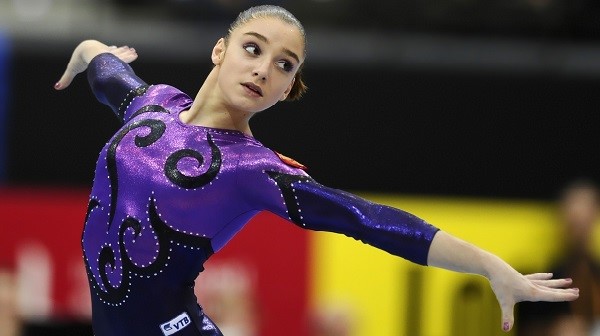
Do you think Aliya Mustafina can beat either Simone Biles or Larisa Iordache at Worlds this year and get at least a silver in the all-around with her new coach and possibly some new upgrades? What will her new upgrades be?
I think she can probably beat Larisa with some upgrades, especially since Larisa has sat out most of this season due to injury so we don’t know what kind of shape she’ll be in at Worlds. I don’t think anyone can beat Simone at the moment, however…not if Simone has a hit competition, anyway. Aliya definitely has a shot at the podium and looked fantastic at the European Games but if she makes mistakes as she did last year, it’ll be close, and she could find herself just outside the medal standings once again. But a solid and clean Aliya is definitely a medal threat. Also, as I’m not Aliya or her coach, I can’t say what her new upgrades will be, though I would hope she finally gets around to changing her construction of her beam routine. I can’t believe that wasn’t a priority between Worlds and Euro Games!
Why do you think in WAG that other countries outside the Big 4 are not able to break into the medals, especially during the Olympics? MAG seems to be able to have a diverse amount of medals from different countries, even with China, Japan, GB, USA, etc usually taking the top spots. Do you think it is a lack of funding for WAG programs in other countries, or are the Big 4 really that dominant?
I think it’s a combination of a lot of things. Some countries like Great Britain, Italy, and Germany really do have a tremendous amount of funding, possibly even more than Romania or China, but are lacking elsewhere…lower populations mean lower pools to choose from, no history like Nadia’s or Mary Lou’s to inspire children to get involved in the sport, other sports just being more appealing to children because of their popularity in the country, a weak developmental program putting athletes at a disadvantage at a young age…definitely a lot of factors that go into it.
Just remember that the U.S. once wasn’t this dominant and in 2000, couldn’t even get a team medal, and then they shifted their program structure from the foundation right on up and now things have changed immensely in the past 15 years. Again, they have millions more people in the country than say Great Britain, so they have more people who go into the sport, and that’s a big help, but it definitely took the restructuring of a program to make them a power country in the sport and that same thing could happen for countries outside the Big 4 that are close but never really get all the way there.
And yes, the dominance of the Big 4 has been so great for so long, it is very difficult for outsiders to play catch-up, especially when the leading teams have more experience finishing on the podium and can come into the competition looking unshakeable. I think sometimes when teams like Great Britain or Italy especially start to get close, they get nervous and gymnasts make mistakes. Like, last year, several teams got ahead of Romania in qualifications, but then fell apart in finals, likely under the pressure of “could we actually finish 4th at Worlds and defeat a program like Romania?!” That messes with your head, for sure, and definitely brings the jitters into your competition.
There are certainly gymnasts who have broken in as individuals, like Beth Tweddle and Vanessa Ferrari and others who maybe don’t medal but who at least get close to the podium consistently, so the talent is there, but I do think that smaller countries just have a really hard time fielding teams with girls that can ALL reach the level of a Tweddle or a Ferrari. Like, the U.S. can put up five gymnasts all hitting 58+ in the all-around because there are a thousand level 10 gymnasts at any time who could conceivably go elite, giving them a HUGE pool to choose from, but other countries are lucky to have a thousand gymnasts competing at the equivalent of level 5 in the U.S. so that’s definitely a huge part as to why they can’t really get there, in addition to the lack of developmental programs or what have you.
In the population discussion, Romania is kind of the anomaly because they have a comparatively tiny population, with like ¼ of Germany’s and ⅓ of Great Britain’s and Italy’s, but they have also been around as a gymnastics power country since the beginning of modern gymnastics as we know it (i.e. 1970s onward) so their training institutions have been in place for awhile and they have better methods for bringing in children with potential and things like that. But the U.S. and Russia each has several hundred million people, and China has over a billion, so that’s a huge advantage to them!
What’s the deal with regional qualifying for NCAA? Does the RQS alone determine qualification for regionals, or is it some combination of RQS, record, and conference championship performance that determines who knows?
The RQS alone determines regional qualifying for NCAA. The RQS is the season record and is a bit more sophisticated than simply averaging totals and ranking teams that way (averaging is how teams are ranked for the first half of regular season because they don’t have enough meets under wraps to pull together an RQS). The RQS pulls scores from all regular season meets as well as conference championships, drops the highest score, and then includes the next six scores, three of which must be away scores, and then averages that. The top 36 teams ranked via RQS qualify to regionals, and are seeded into each regional location based on their spot in the rankings (though many of the lower-ranked teams are assigned based on geographical location rather than ranking for logistical purposes).
Have a question? Ask below! Remember that the form directly below this line is for questions; to comment, keep scrolling to the bottom of the page.


Article by Lauren Hopkins
 The Gymternet
I am loving the new frequency of publishing new YATGA ! Keep ’em coming!
LikeLike
regarding the question about countries outside the big 4:
I can only speak for Germany, but our problem is much bigger than just the lower population.
1. Gymnastics is very unpopular. Our number 1 sports is soccer and it takes up all media cover. Gymnastics is never on TV (maybe 10min a year, and that’s usually MAG, not WAG). Most people associate gymnastics with horrible childhood memories of PE lessons, not artistry. They would never send their children to a sport they don’t know about or dislike.
2. Since there are not many kids who do it, there aren’t many gymnastics clubs in Germany. Lots of towns have several soccer/ dance/ …clubs, but not a single gymnastics clubs. Also, unlike people from the US, Germans are not very much into driving long distances. If there isn’t a club within a 30min drive (and that’s already really far!!), gymnastics is not an option.
3. Our mentality on sports clubs. In Germany we believe that attending a sports club (or any club for that matter) should be available for EVERYone, not just the kids with wealthy parents. Sports clubs are sponsored by the town / state. Our members only pay an annual organization fee (ca. 100€ per year, often less) and not for the class itself. The clubs can’t afford to pay their coaches. That is why most of us work voluntarily or aditionally to being a teacher/ student…. In the whole region of Bavaria there are only 3(?) professional coaches who make a living out of gymnastics.
Another result of this mentality is that many clubs don’t have a gym of their own. The town let them use school gyms, but they have to set up all the equipment before every class and take it down afterwards, and that takes up quite some time. Also, equipment is expensive and difficult to store. So we often have only 2 instead of 20 beams, 1 vault, 1 ub…
The idea of letting everyone take classes for almost nothing works out very well in sports that only need some grass and a ball, but not so much in sports like gymnastics.
4. In Germany, many people think bad of parents who let their children do competitive gymnastics. Training several days a week, doing conditioning and flexibility training, not having much free time… is highly controversial. High level gymnastics is often considered to be to hard on kids and gymnasts’ parents to be overambitious.
5. The school system: Homeschooling is forbidden in Germany.
Yes, there are exceptions: Stuttgart for example has a beautiful gym and a few professional coaches, some parents don’t mind being judged and sometimes schools let competitive gymnasts off from not-so-important subjects (music, arts, PE) so that they can train twice a day.
However, with these premises we don’t ever have as good chances to being succesful as the big 4.
LikeLike
I think you were spot on with all those points, and I believe they apply for the Scandinavian countries as well.
LikeLike
I understand what you’re getting at re: the 2000 US Olympic team, and I don’t mean to be pedantic, but I want to quibble with the “couldn’t even get a team medal” only because that team is now literally the bronze medal team…and those girls had such a rough Olympic experience that I hate to see them deprived of the acknowledgment they belatedly received.
LikeLike
In my opinion Aliya should REALLY focus on her twisting form rather than her beam..i know thats a thing everyone has been criticising her for but its reeeally annoying ..especially if she wins certain tie-breaks..say at the olympics thanks to the E score..its a joke to me! I really dont like the fact that she gets ahead of everyone just because shes mustafina. Dont get me wrong i love her gymnastics but shes often judged unfairly..if i think of a gymnast like wieber..who had tremendous form and how she was scored at the olympics.. I just hate the double standard international judges have…its supposed to Be a sport where merit is what matters..and its not like you can fake anything its there in front of everyones eyes (i know this is a large complicated topic..) therefore she should at least structure her FX differently TAKING OUT all her twisting passes and making her wins more believable!. Its really a contraddiction seeing her wonderful artistry..elegant dance…and then those awful twists..its very unprofessional..and ugly for a champion like that…she has won everything and still presents herself like that ..it makes me think less of her….and doesnt she have coaches now?! Sorry thats what i think.
LikeLike
I completely understand and I basically agree with you. But after looking through the code of points (correct me if I’m wrong) the penalty for her bent awkward knee twisting form is only one tenth. Unfortunately, they are probably thinking that it isn’t worth trying to fix it since it’s such a small deduction. I really wish they would though, it’s atrocious
LikeLike
While I agree that Mustafina should work on improving her twisting technique, fixing her beam is definitely a higher priority and also a much easier fix. She needs to change her flight series on beam from two front aerials to one that is much more reliable. The series she does now is risky because it’s much harder to connect two front aerials than to connect other series such as a bhs loso. She had this problem during Beam EF at 2014 Worlds and she failed to do a series. She doesn’t have another series in her beam routine that meets the Composition Requirements so if she misses the only one she has, her D score takes a big hit. It’s an unnecessary risk and it’s a very silly one. She has done other series on beam in the past so it would be easy to change back to an older and more reliable series. Much easier than changing her technique on twisting skills, especially as she has already worked on this without much visible improvement. At this stage in Mustafina’s career, it is very difficult to change or correct technique on skills. It’s not impossible, but it is extremely hard.
LikeLike