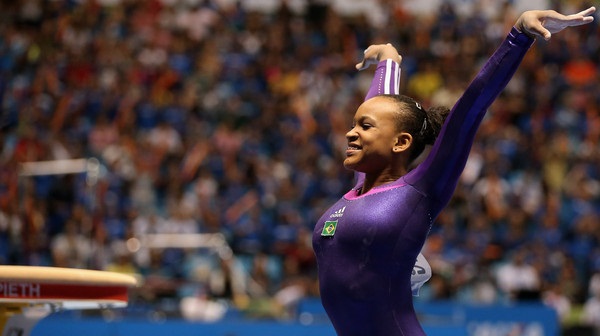
It’s time for the 71st edition of You Asked, The Gymternet Answered! We apologize if we haven’t gotten to your question yet, but we try to answer in the order in which they were received (unless they are super relevant and need to be answered in a timely manner). Something you want to know? Ask us anonymously by going through the contact form at the bottom of the page.
Why do women only do four events but men do six? Was there a time when they did the same amount?
Gymnastics is always evolving, and from about the 1930s until about the 1950s, women competed on rings, high bar, and parallel bars. Considering the modern format was a product of the 1950s, a time when it was the norm to differentiate between how men and women should look and behave in society, the events are likely separated based on things like gender roles and the physical differences between men and women – the men got the arm strength events whereas the women had events where elegance and performance were highly valued.
The high bar and the parallel bars were meant to be feats of strength and difficulty, for example, and these kind of morphed into the uneven bars, which at the time were basically just a modified set of p-bars for women, with the difference being one bar raised higher than the other. Women weren’t expected to swing giants or showcase daring release moves or bar changes on these new lady p-bars, and the lower bar was used as a way for the women to briefly pause mid-routine, resting the lower half of their bodies against the bar. The rings, another arm strength event, disappeared for the same reason – women’s ‘weak’ shoulders and arms.
Today, little girls train giants on bars with ease, so clearly lack of arm strength in women is not a problem and they could probably be quite successful on events like rings or high bar. In fact, whenever I ask female gymnasts which men’s event they’d most like to try, it’s usually one of those that gets picked (aside from the occasional sadist who chooses pommel horse, another arm event the ladies of the 50s were considered too dainty to try).
A good example of someone breaking the mold is Julia Sharpe, who not only competes on all six men’s events at the national collegiate club level, but who also continued her training on these events during and after being pregnant with twins. At this point, though the nature of the sport continues to evolve, the structure of six events for men and four for women has been pretty static for about 60 years so I don’t see it changing anytime soon, but women can absolutely physically do the men’s events even if the 1950s says they can’t.
Rebeca Andrade has trained the Nabieva and with an ACL tear, she’ll probably be able to train that skill before she can train on her knee again. Do you think Andrade will make the Olympic team? She is by far their number one bar worker, which Brazil needs desperately, and you don’t need a strong knee for that.
I do think she’s pretty much a lock for the team. If everyone’s healthy, I’d be surprised to see anyone but Andrade, Flavia Saraiva, Daniele Hypolito, Jade Barbosa, and Lorrane Oliveira make it, assuming they qualify a full team. Of course, you never know who can explode next year…but this is a well-balanced team and I think Andrade is an integral part. Even last year doing the all-around just coming back from injury, she was one of the best on the squad. I don’t know if she’ll be throwing Nabievas anytime soon but she’s definitely their best hope on bars either way and I’m sure Alexandrov is progressing her in a way that makes sense for 2016.
Do you think the 2020 rule change will encourage any 2008 girls (or prior) to return to gymnastics, considering it’ll be easier to train their pet event? For example, Nastia Liukin returning just to do bars, or Alicia Sacramone for vault.
I don’t think so, honestly. There’s really only one spot that will go to a true specialist, since the other non-team spot will likely be for an all-arounder who can replace one of the team gymnasts if necessary. So it wouldn’t make a lot of sense for a lot of gymnasts to come back to fight for one spot after they’ve been retired for so long…you never know, it could happen, but the likelihood of going to the Olympics as a specialist for the U.S. in 2020 is super slim, which is why the focus for that quad will be on all-arounders. I could see more recent elites like McKayla Maroney try to make a run as a specialist but I definitely don’t think we’ll get a huge influx of past gymnasts newly returning to the sport all for the tiny hope of being offered the one available spot.
Can you please help differentiate between the L-grip and the reverse grip? I know the differences on paper but I have a hard time distinguishing between the two during a routine.
I spoke with our awesome triple threat former gymnast and current judge/coach Sarah Chrane to help you out with this one because I honestly almost never pay attention to grip. She says for reverse grip, the wrists turn outward, whereas for L-grip, they turn inward. A simple way to keep it in mind is that it’s reverse grip if the pinkies are facing each other and it’s L-grip if the thumbs are facing each other. To play around with it, put your arms in front of you and rotate them through a “thumbs up” position until your thumbs point out to the side. That’s reverse grip. For L-grip, do the same thing, but pass through the “thumbs down” hand position.
Do you think it is a rather big conflict of interest for Nellie Kim to head both the FIG and the Belorussian program?
Inherently, no, but I think with what we saw last year, it clearly is a conflict of interest. If she goes about her business as head of the Belarusian program entirely separate from her role with the women’s technical committee, then it’s no big deal, but when she begins to use her international connections to recruit gymnasts to her country’s team to make sure they get a spot at the Olympics, it’s a bit unfair. Unless she’s going around to every country and helping them out by bringing in lower-level U.S. elites to make them more competitive, I think it’s definitely an issue. I think it would still be wrong to actively recruit elites from other countries if you’re not the head of the WTC, but that connection makes it look super shady in my opinion.
Could you please explain and give examples of the acro connection rules on beam that specify connecting skills with rebound vs no rebound?
Back with Sarah Chrane for this one because no matter how many times I look into this rule, I will immediately forget it. Basically, to simplify, rebounding means it keeps going in the same direction. For example…a bhs + loso, a front aerial + side aerial, and a side aerial + bhs (because a side aerial finishes backwards). All of these travel in the same direction with the momentum of the second flip following the momentum of the first flip.
A non-rebounding connection, on the other hand, is if it travels one way and then travels back the other way, like a front aerial + bhs, where a gymnast has to stop her forward momentum to begin backward momentum for the next skill in the connection. There’s no rebound because you’re not continuing the motion directly from one skill into the next.
The U.S. has a large team of incredibly talented seniors. The juniors turning senior in 2016 lack international experience and have lower start values. If no one is injured, do you think it’s realistic for any new seniors to make the Olympic team?
At this point, going based on how the juniors looked in 2015 since we haven’t seen them yet this year, I’d say I would be very surprised if a new senior made the Olympic team. However, you never know what can happen. Some of them – especially Norah Flatley and Laurie Hernandez – are going to come out with major upgrades this year.
There’s so much depth from seniors who debuted in previous years, though, so it’s not going to be easy for a new senior to step it up, especially given their lack of experience. With Kyla Ross in 2012, she had been competing internationally since 2009, was never injured and had to miss a season, and was always finishing on the podium. She had more experience than most seniors, so there was no question whether she’d crack under pressure in London. The current first-year seniors, however, have little experience beyond one or two meets each.
There are something like 20 international assignment spots open for seniors this spring, so I’m sure everyone will get a little test, but at the same time I think it’s often easier to rely on those who have proven themselves time and again than it is to take a shot in the dark with someone who went to a couple of low-pressure meets. But if Laurie comes out with a 60+ in the all-around or Norah starts nailing a 6.8 beam routine at every camp, then I’d say yes, for sure, they could make the team.
Have a question? Ask below! Remember that the form directly below this line is for questions; to comment, keep scrolling to the bottom of the page.


Article by Lauren Hopkins
 The Gymternet
As of now, what are your predictions for the U.S. Rio Olympic Team?
LikeLike
Do you think the strength basis of the men’s events, as opposed to the acrobatic/flight/grace basis of the women’s events, is the main contributor to the age disparity we see in gymnasts? If women did the same events as men, with all the emphasis on holding strength poses, would the shelf life and age of female gymnasts increase?
LikeLike
In L-grip, the pinkies are still facing each other, yes? The only grip in which thumbs are facing each other is forward grip.
LikeLike