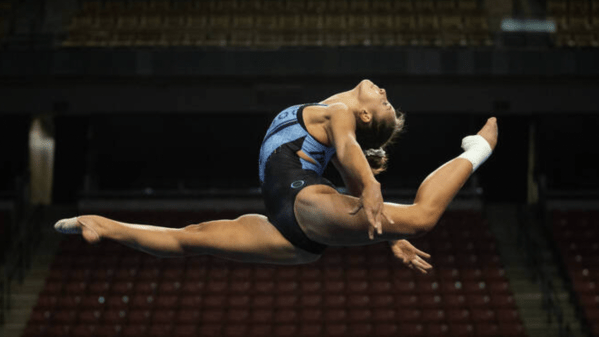
Levi Jung-Ruivivar
The team from the United States had an easy time winning the gold medal in the mixed team cup competition at the DTB Pokal meet in Stuttgart, leading the preliminary round by more than four points before going off to defeat Germany in the final by nearly eight points.
Prelims included three rounds of competition with two women and two men going up in each round, and a total of six athletes on the team.
On the WAG side, the U.S. opted to go with Karis German on bars, where she earned a 13.35 after catching her straddle Jaeger, Nabieva, and Downie to Pak; Katelyn Jong on beam (she earned an 11.7 after falling on her acro series) and floor (13.25 for a routine that included a great double double and a near-stuck double pike); and Levi Jung-Ruivivar across all three, doing well to earn a 13.25 on bars, a 12.75 on beam with just a few wobbles, and a 12.6 on floor, where her routine didn’t have a ton of difficulty but was lovely and mostly clean.
The men’s side was led by Colt Walker with a 14.2 on floor, with his front full to piked double front a highlight, and a 14.2 on vault, where he competed a powerful handspring randi but had a big stumble on the landing. Curran Phillips got a 14.2 on vault for his Yurchenko 2½, which was great in the air but had some steps on the landing, and a 12.9 on high bar, and Riley Loos put up a 13.3 on floor, showing a couple of hops throughout, though his front full to double front opening and triple full dismount were great, and a 12.7 on high bar.
In the gold match, they were paired with the host country, and easily got the win, capitalizing on big scores on vault from Jong with a 14.35 for her Yurchenko double and from Jung-Ruivivar with a 13.9 for her lovely Yurchenko 1½. The men opted to compete on parallel bars in the final, another smart choice as Walker was able to put up clean and solid work capped off with a stuck double front, while Phillips showed off excellent pirouettes and just minor handstand adjustments to earn a 15.05, bringing the U.S. to a 57.950.
The Germans finished in second place in qualifications, securing them a spot in the gold final with a very smart strategy that all but guaranteed them the silver medal. Knowing they likely wouldn’t beat the U.S. for gold, they opted to compete most of their best apparatuses in prelims, hoping to finish in the top two to reach the gold match, which meant they’d earn the silver medal even with a billion falls in this bracketed competition.
The strategy worked, as the Germans did end up beating out both Italy and Canada to land in the gold final, and despite struggles in the end that caused them to score three points lower than both bronze match teams, the scores didn’t matter and the silver was theirs.
The team fielded only two WAG athletes, with both Sarah Voss and Lea Marie Quaas doing all three apparatuses with good enough success. Voss hit bars for a 12.85, a clean Yurchenko full for a 13.25, and a bit of a wobbly beam routine, but one with lots of good saves, that earned a 12.8, below her potential but a good score given the issues. Quaas, meanwhile, started with a solid bars set, finishing late on a couple of handstands, but managing a 12.35 before moving to vault, where she was a bit piked down on her Yurchenko full to earn a 12.9, and she finished on beam with an 11.9, wobbling quite a bit throughout, and ultimately falling on her front aerial.
There were three competitors on the MAG side. Dario Sissakis opening floor with a sat double front to earn a 12.6, though he came back strong on vault with a Kas 1½ that earned a 14.2. Carlo Hörr also had a fall on floor, sitting the opening 1½ to double front before struggling with landings on several subsequent passes to earn an 11.6, though he too had a good comeback routine with a 13.35 on pommel horse, letting his form get a bit loose near the end, but it was a good hit overall. Finally, Glenn Trebing added a second hit pommels routine to the team, muscling the dismount a bit but showing no major mistakes for a 12.45, and in the final round he hit a clean Kas full with a step for a 13.859.
Floor definitely isn’t a standout for the German women, but I was impressed to see Voss look really strong there in the final, competing a triple full, double pike, 1½ to front full, and double full to score a 13.1. Unfortunately, Quaas had a slip and fall on the 2½ at the end of her routine, which followed a few other mistakes, and she was only able to bring in a 9.9. The men were able to hold the team afloat on parallel bars, with a 13.2 from Sissakis, who had some adjustments throughout, and then a 14.25 from Trebing, who had beautiful transition work and a strong double pike dismount, leading the team to a 50.450 total.
After finishing in third with a 153.950 and in fourth with a 152.300, Italy and Canada were seeded into the bronze match, where both teams outscored Germany but weren’t eligible to outrank them due to the bracketing system.
The Italians had a lot of uncharacteristic mistakes during prelims, both large and small. Manila Esposito led the team on floor, where she had a few iffy moments but was otherwise good enough for a 12.5, though Desiree Carofiglio only managed an 11.85 there after a low landing on her final pass. On bars, Esposito fell on her Church and came close to missing the dismount, getting just a 10.65, though Elisa Iorio showed a very nice routine for a 13.95, getting deducted consistently for little things throughout, but as a whole it was a great set. In the third round, Esposito came back on beam with a hit for a 12.8 followed by Iorio with a matching score, breaking at the hips on the side aerial, but the rest was great.
The men started off a bit slow on floor with a 12.3 from Mario Macchiati, who sat the 1½ to front double full, and a 13.05 from Lay Giannini, who had a hit with a randi, 2½ to punch front, arabian double front half-out, 1½ to front full, and triple full with a lunge back. Macchiati got some redemption on pommels with a slightly messy but controlled routine for a 13.0, while Yumin Abbadini did some lovely work there, earning a 13.3 after just muscling the handstand into the dismount for his only real error. Parallel bars was the strongest outing for the team, where Giannini fought through some minor handstand issues to earn a 13.75, while Macchiati started off a bit slow but cleaned up throughout and put up a 14.0.
Both the women and men opted for vault in the final round, which was a smart choice and helped them reach the bronze medal with a 53.250 despite some major errors from the men. Esposito started them off with a very clean Yurchenko full for a 13.55, while Carofiglio earned a 13.5 for her Yurchenko 1½, which had a big step over out-of-bounds. Unfortunately, both Giannini and Macchiati had falls, with Giannini pushing his hands forward and down to the mat on his handspring double front while Macchiati stumbled back and sat his Kas 1½, both earning scores of 13.1.
Sydney Turner and Amy Jorgensen led the WAG team for Canada in prelims. Starting on vault, both hit clean Yurchenko fulls, with Jorgensen getting a 13.1 with just a step to the side while Turner went 13.25 with a lunge back. On bars, Jorgensen’s routine was lacking in difficulty, but she hit well and stuck the double tuck to earn an 11.75, and Turner’s routine was a bit more exciting, though she had one little struggle as she muscled through the front giant into the piked Jaeger. Still, it was a solid set overall, capped off with a great double layout, and she earned a 12.5 there before going on to get a 12.25 on floor, where she had a couple of landing faults, but again looked pretty good. Jorgensen unfortunately sat her double wolf turn in her set, in addition to seeing some landing deductions add up, so she was only able to manage a 10.95 there.
The men started on parallel bars with an excellent set from Félix Dolci earning a 14.3, followed by a mostly clean routine from Zachary Clay, who only really had a few minor hand adjustments as his most noticeable faults, bringing him to a 13.75. Pommel horse wasn’t super high-scoring, as Félix Blaquiere’s set was a bit easy and he had some hip form issues throughout to earn an 11.25, while Clay had a slip while in handstand early on and then lost his rhythm during circle elements to count a fall for a 12.55. Finishing up on high bar, Blaquiere again did some solid work, especially in his Kovacs and Tkachev releases and a near-stuck full-twisting double layout, earning a 12.85, and Dolci capped them off with a 13.8 for a great routine bolstered by a great double-twisting double layout dismount with a small hop.
With the women going up on beam in the final, it seemed like they’d be at a major disadvantage to the Italians on vault, but Turner was excellent in her set, hitting a layout stepout mount, side aerial to layout stepout, front aerial to jump series, and a great double full dismount for a 13.6. Jenna Lalonde made her first appearance of the meet for an event that’s usually a great specialty set for her, and it was a decent routine, but with minor wobbles adding up, she only brought in a 12.85.
As with Italy, the men opted to do vault in the final, beginning with a 13.9 from Blaquiere for his Kas full. It looked like even with the women slightly behind the Italians, the Canadians could actually get the medal win, but then Clay had some vault drama of his own, sitting his handspring double front for a 12.7 to leave the team just two tenths off of the podium.
Full results from the mixed cup are available here.
Article by Lauren Hopkins
 The Gymternet