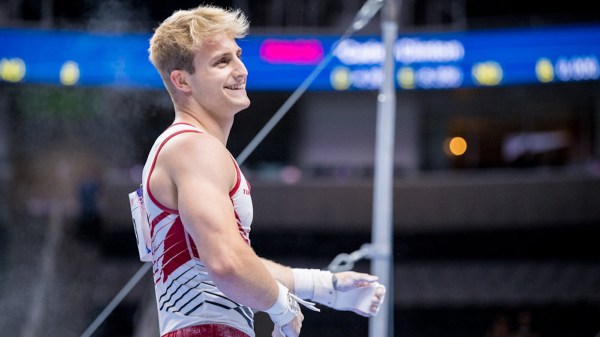
Colt Walker
The men’s competition at this year’s U.S. Championships was full of excitement, drama, and surprises, but best of all, it was stacked, with a level of depth that’ll make it incredibly hard to figure out a five-person team for next month’s world championships.
In his second year of senior competition, 19-year-old Asher Hong won the title with a combined score of 170.930, climbing up a couple of spots on the podium after getting the bronze in 2022, while his Stanford teammate Khoi Young, 20, took the silver with a 169.455, and Fred Richard, who became a senior at the international level this year at 19, was close behind as the bronze medalist with a 169.311.
But while all three of these men put together some of the most difficult routines of the competition to finish on the podium, it was Colt Walker, the 21-year-old who has spent the majority of 2023 recovering from an injury, who surprised to not only finish fourth with a 168.811, but who did it with zero difficulty bonus and who actually scored the highest in this competition with all bonus removed.
Walker isn’t someone I had on my worlds team shortlist until tonight. With a fall on his straddle Tkachev on day one, he was held back to sixth place in the standings, making him a bit of an outlier for world championships team contention. But with a hit on high bar today in addition to improvements in his scores on floor, vault, and parallel bars, Walker catapulted to an 85.000 all-around total, putting him within tenths of the podium without any added bonus, the highest score for any U.S. man so far this year.
If you were to rearrange the rankings based on scores without bonus, Hong and Young are tied for second behind Walker, while Richard is fourth, making for a bit of a shuffle when comparing the actual results. While Walker is incredibly balanced and had a super consistent second day of competition, the others had more highs and lows, with Hong always held back by his scoring potential on pommel horse and high bar (though it’s incredible to see how much his consistency there has grown over the past couple of years), Young a bit behind on rings, parallel bars, and high bar (though he’s still lovely to watch on all three), and Richard suffering a couple of falls on pommel horse.
I still think there’s room for all four of these men on the worlds team, though, as they can all add a lot of value in a team final situation. If anything, Walker’s late-season resurgence could affect two of the all-arounders already in the mix – Olympian Yul Moldauer, who finished fifth with a 167.446, and Paul Juda, also newly back from an injury and who took the bronze at the U.S. Classic a couple of weeks ago, but who ended up sixth here with a 167.202.
With typically strong work on pommel horse and high bar, Juda is still an incredibly valuable asset, as his pommels work is good enough to eliminate the need for a specialist on that event, while high bar is generally a weak spot for the U.S. team, and Juda can be counted on for one of the team’s best scores. He also looked excellent on floor here, winning the title, and he has routines that could be usable elsewhere, though his consistency on pommel horse is questionable given that he’s fallen in two out of three routines this month.
Moldauer ended his first day of competition in second place, looking a bit weak on high bar but otherwise showing fantastic work. Today, however, he missed his Kolman on high bar, looked a bit rough overall on floor, where he sat a punch front after some earlier mistakes, and then had to muscle some skills on pommel horse, leaving him at a lower score than he’s capable of, though he still finished third there, and he also led the competition on parallel bars.
Walker, Juda, and Moldauer are all similar in how they have the potential for greatness, but also have shown that there are reasons to not trust that they can be reliable in a three-up three-count final. Of course, unpredictability is part of the sport, and an athlete with a 100% hit rate in the first half of the year can show up at worlds or the Olympics and fall on every routine, and the opposite can be true for athletes who bomb domestic meets and then thrive on a major international stage, so how serious is anyone’s consistency or lack thereof right now, or ever? Enough to leave them at home, or would someone like Juda be impossible to resist for both a stellar all-around program and what he can do on an apparatus that has consistently tripped up the team?
Rounding out the top 10 here were Donnell Whittenburg in seventh with a 167.081, Shane Wiskus in eighth with a 166.850, Cameron Bock in ninth with a 166.450, and Riley Loos in 10th with a 166.238.
I was so impressed with Whittenburg’s consistency across both days of competition. Though he dropped a bit in the standings compared to last year without the heftier bonus points to keep him afloat, he actually looked pretty great, hitting both of his weak events – pommel horse and high bar – both days while earning top-five scores on floor, rings, and vault. While he’s not exactly a top contender this year, I think there’s a lot he can contribute in a team setting, and hope he’s seriously considered.
Wiskus had some struggles here and there, though overall looked pretty solid, and he hit nearly every routine, though he’s just not doing enough right now to stand out in a crowded field, and his only top-five finish was floor, where he was fourth. The came can be said for Bock and Loos, who are generally solid across the board, but again don’t have the skill level to contend with some of the stronger guys, with Bock’s sixth-place finish on high bar his top placement, while Loos had his best work on rings, where he was seventh.
Outside of the all-arounders, the top worlds contenders are Curran Phillips, who had the third-best single vault score and won the silver medal on parallel bars with a mistake, and Stephen Nedoroscik, the top pommel horse worker of the competition. I do think Nedoroscik proved last year with his miss in the team final how risky a single-event specialist is, and don’t know if they’d want to take that risk again, while Phillips is a stunner on parallel bars and has an exciting high bar routine, but has been somewhat inconsistent this season, including at Pan Ams, the Baku World Cup, and here.
It wasn’t a perfect competition for anyone in San Jose, and there’s a lot for the men to work on over the next few weeks in the lead-up to Antwerp, but with the worlds team being named based on these results instead of at an upcoming camp – giving the guys the chance to focus on worlds instead of on the trial meet, at their request – there’s nothing else that can be done for those who are team hopefuls.
With so many options, and so many pros and cons for nearly everyone in the mix, it’s not going to be easy to select a team, but that’s what’s so exciting about the U.S. men’s program right now compared to recent years. The number of options they have could create several teams that could all work for different reasons, and while there’s going to be a lot of disappointment when someone who could do great things at worlds doesn’t make it, too many options is a fantastic problem to have, highlighting the growth of the program in recent years, especially among the young guys who are keeping the veterans on their toes.
Article by Lauren Hopkins
 The Gymternet
Per scores without bonuses: Khoi, Yul, Paul, Donnell, Curran.
I think they’ll choose: Khoi, Asher, Fred, Paul, Stephen.
LikeLike
I have Curran over Stephen, but worry about his consistency. I don’t think they’ll take Stephen again this year after what happened last year, but we’ll see! I’m still unsure of the Paul situation but I think it’ll either be him or Colt in that spot.
LikeLike