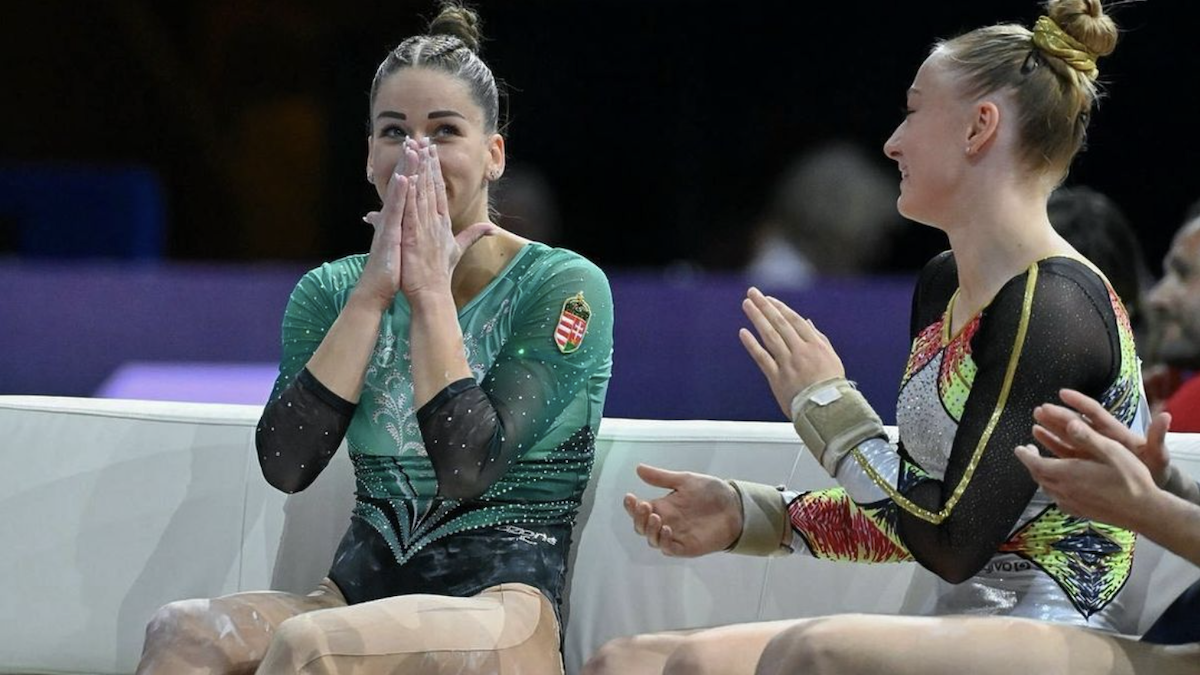
Zsofia Kovacs
This weekend, the Romanian federation held a small international meet in Bucharest where we got to see a number of Olympians preparing for Paris along with a handful of hopefuls, with both Romania and Hungary using this competition to determine its final rosters.
Following the competition, Romania selected its top four all-arounders from this meet – Ana Barbosu, second with a 54.550; Lilia Cosman, fourth with a 52.050; Amalia Ghigoarta, fifth with a 51.600; and Andreea Preda, sixth with a 50.650 – along with Sabrina Voinea, who withdrew here due to some tendon pain, for its Olympic squad. This is the same group of athletes who helped Romania to a 10th place finish at worlds last year, putting them in position to qualify a full team for the first time over a decade after qualifying only individuals in 2016 and 2020.
There were no surprises here, with these five athletes the clear strongest at the moment. Romania has quite a few first-year seniors this year, but none are close to the same level as its established group of senior athletes, with Miruna Botez the closest to the top group with a 46.900 for 10th place. We also saw some great beam work from Gabriela Vanoaga, who won bronze on beam with a 13.033.
While the Hungarian federation didn’t qualify a full team to Paris, by finishing 15th at worlds last year they were able to qualify one non-nominative individual spot, which ultimately came down to two-time Olympian Zsofia Kovacs and Zoja Szekely, who missed out on a nominative individual spot at worlds after teammate Csenge Bacskay snuck into the vault final on a technicality.
Without a plan in mind to select an athlete, and with Kovacs having not competed since last September due to an injury, Hungary hastily chose the RomGym Trophy as the one-and-done route for determining who would compete in Paris, with the coaching team deciding that whoever had the higher score on bars would get the spot.
On the first day of competition, Szekely had the second-highest bars score of the meet with a 14.050, while Kovacs fell three times, earning just a 10.6 to miss the apparatus final. It seemed sealed for Szekely, but on Sunday another athlete withdrew from the bars final last-minute, opening a spot for Kovacs, who earned a 14.2 to win the silver medal, while Szekely ended up sixth with a 12.6. Though Szekely’s two scores outweighed Kovacs’ two, the federation clarified that they meant the single-highest score would go, which was Kovacs’ 14.2, and they announced that Kovacs was their choice for Paris a couple of days later.
It’s admirable that Kovacs was able to come back so quickly and prove herself with a competitive routine, but it’s also quite heartbreaking that once again Szekely was put into a position where it looked like an Olympic spot might be hers only for something completely out of her control – the FIG’s messy qualification rules at worlds in the first instance and an entirely unrelated athlete withdrawing from the bars final here – to take her out of the mix. I don’t think a score a tenth and a half higher than Szekely’s score should have outweighed what Szekely has contributed to the Hungarian program all quad, including being a key reason why they placed high enough as a team to earn this non-nominative berth at worlds last year in addition to competing a total of 12 bars routines in 2024 alone, with all but two of them mistake-free. Kovacs is of course a wonderful athlete, but it seemed like the federation was pushing for her from the moment they earned this spot despite her not being healthy enough to compete until this weekend. The odds were stacked against Szekely from the start, with Kovacs clearly the favorite, and I believe even if Szekely had the higher bars score this weekend, the federation still would’ve found a way to justify Kovacs.
As for the athletes who had already qualified to Paris as individuals, we saw Kaylia Nemour of Algeria and Filipa Martins of Portugal joining Barbosu on the all-around podium, with Nemour earning a 56.900 for gold while Martins had a 52.200 for bronze. There was also Lena Bickel of Switzerland, who finished seventh with a 50.100, Hillary Heron of Panama, who was eighth with a 49.300, Lili Czifra of Hungary, who was ninth with a 47.450, Jana Mahmoud of Egypt, who competed every apparatus but vault, and Csenge Bacskay of Hungary, who competed only on vault.
Nemour looked fabulous across both days of competition, putting up Olympic medal contender routines on both bars and beam. On Sunday, she won the gold medals on both, with a 15.667 to take the bars title and a 14.733 to win beam, earning both titles by more than a point each. She also ended up taking the floor gold with a 13.533, showing a high level of both difficulty and execution on an apparatus that isn’t typically one she’s known for, but where she’s stellar nonetheless.
Additionally, Barbosu won gold on vault with a 13.534 average, Bickel won silver on beam and bronze on floor, Sara Peter won silver on vault, Ghigoarta won silver on floor, Bacskay won bronze on vault, and Cosman won bronze on bars. Czifra finished fourth on beam and fifth on floor while Mahmoud was seventh on beam and fourth on floor. Heron qualified into every final, finishing fifth on vault and beam as well as eighth on bars, though she withdrew from the floor final, while Martins withdrew from her apparatus finals as well.
There was also a men’s competition here, which most notably featured the Canadian team already named for Paris getting in some extra practice after arriving in Europe earlier this month. Three Canadians led the all-around competition, with Félix Dolci taking gold with an 81.100, René Cournoyer getting silver with an 80.650, and Samuel Zakutney finishing third with an 80.250, though with two-per-country limitations, the bronze medal ended up going to Omar Mohamed of Egypt, who qualified to Paris as an individual, with an 80.000.
William Émard, Zachary Clay, and alternate Ioannis Chronopoulos also represented Canada here, while we saw performances from Romania’s individual qualifier, Andrei Muntean, on parallel bars, and Hungary’s individual qualifier, Krisztofer Meszaros, on pommel horse, rings, parallel bars, and high bar.
During Sunday’s apparatus finals, Dolci won the gold medals on floor and high bar, Meszaros won pommels and parallel bars, Cournoyer won rings, and Mohamed won vault.
Complete results are available here.
Article by Lauren Hopkins
 The Gymternet