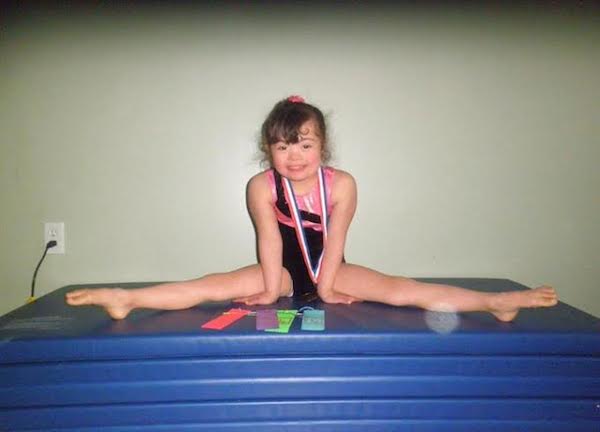
Amina Dallahi is ten years old. Like any other ten-year-old girl, she loves to dance, and especially loves gymnastics. But like approximately 400,000 people living in the U.S., Amina has Down Syndrome. She is also a cancer survivor.
Amina started gymnastics at the age of two and was hooked from the very beginning. Since individuals with Down Syndrome have decreased muscle tone, gymnastics was the perfect activity to increase muscle tone while also improving coordination, core strength, spatial awareness, and balance in addition to fostering social interaction amongst peers. Individuals with Down Syndrome also have increased laxity in their joints, and while hyperflexibility is an advantage for Amina in gymnastics, it also causes difficulty with muscle stabilization, so Amina must have frequent x-rays on her neck to ensure there is no risk of injury to the spinal cord.
In addition to physical challenges, individuals with Down Syndrome also experience cognitive, speech, and language delays. Due to the cognitive challenges, Amina requires a one-on-one assistant in gymnastics. For the majority of her career, Amina’s mother, Jeannie Dallahi, was her aid until Amina “expressed the desire to not have her mom come with her.” That’s when Jeannie trained Sam Lernay, a high school student and gymnastics teaching assistant, to work with her. “This has been a very successful model where Sam…can help keep Amina on track throughout the class and spot her whenever needed. Sam steps back when she can to give Amina as much independence as possible.”

But while gymnastics is Amina’s true passion, there was a time where her health kept her from the sport for two whole years. In 2008 – just one month before Amina’s fourth birthday – she was diagnosed with Acute Lymphoblastic Leukemia, a diagnosis that stunned her family.
“She had been healthy and thriving until one day she didn’t want to walk,” her mother recalled. “At the time, her verbal skills were very limited so it was difficult to know what she was feeling.”
Amina immediately began a chemotherapy treatment at Children’s Hospital Boston, which lasted 25 months. During this period, Amina lost her hair; suffered serious infections due to the immune suppression caused by chemotherapy (including losing the lower right lobe of her lung); went through multiple blood transfusions, surgeries, spinal taps, and chemo infusions; required near-daily oral chemo medication; and experienced painful side effects from the treatment. Amina missed a full year of school, and by her second year of treatment, was only returning to her preschool classroom when she felt well enough to go.
Despite it all, Amina still attended private speech and physical therapy, and stayed fit by turning on the music and dancing along at home. During the two years of treatment, Amina did not do any gymnastics, but she loved it and desperately missed it. Jeannie Dallahi knew her daughter would be fully “back” from her long period of illness when she finally returned to her sport.
In June 2010, Amina had her last chemotherapy treatment and celebrated her sixth birthday. That fall, she started kindergarten and made her triumphant return to gymnastics.
For the past three years, Amina has been on Gym-Ken Gymnastics’ Gym Stars team, an in-house program for gymnastics looking for a little more than a recreational program. Though they do not compete outside of their gym, Gym Stars do up to four in-house competitions per year where they get to wear a team leotard and showcase their routines in front of judges. Amina’s own self-motivation and her teachers’ high expectations of her have been a recipe for success. Through Gym Stars, Amina has learned how to perform under pressure in front of a judge and an audience, and her triumphs within the sport have generated great pride, confidence, and self-esteem.
In 2012, Amina turned eight and became eligible to compete in the Special Olympics. However, New Hampshire Special Olympics does not offer gymnastics as a sport, so with permission from Special Olympics Massachusetts, Amina joined the Legends Team of North Andover and competed in their 2013 Summer Games.
There are six levels in gymnastics competition within the Special Olympics. Levels A, B, 1, and 2 all showcase compulsory skills and routines (meaning that the routines are all the same for every competitor) while levels 3 and 4 allow the athletes to perform their own unique routines and choreography in addition to required elements within the routine. In her first Special Olympics competition, Amina competed as a level 2. She won gold on floor, silver on vault, and bronze in bars, beam, and the all-around.
In New Hampshire, when an athlete turns 16, he or she becomes eligible to compete at Special Olympics Nationals and Worlds, which would not be possible if Amina continued to compete for Massachusetts. This year, Amina’s family decided to have her compete in Special Olympics Massachusetts competitions as an independent entrant from New Hampshire. With their eyes on the future, Amina’s family felt this was the best choice for her, but a hurdle still remained – finding a coach.
This is when yet another gym stepped in to help. Cari O’Shea of Spectrum Gymnastics Academy in Londonderry, N.H., and her mom Cheryl – Amina’s physical therapist – were both seasoned volunteers with the Special Olympics. Cari agreed to be Amina’s coach, and began training sessions with Amina at Spectrum to to prepare for her upcoming competition season.

While Cari had experience volunteering for the Special Olympics, she had never actually coached a Special Olympics gymnast, but found that being a part of Amina’s journey was a special and rewarding experience. “My favorite time was watching her progress from the time we began training to when she competed,” Cari said. “I loved standing by the floor and watching Amina perform her routines and nail everything we had worked on. Her hard work paid off and I loved being a part of it.” With Cari’s help, Amina has learned to perform routines that include cartwheels, round-offs, handstands, forward and backward rolls, bridges, pullovers, back hip circles, arabesques, levers, leaps, and jumps.
Amina’s first competition in April was an assessment round where the athletes were scored and subsequently placed into different divisions for the Boston Summer Games. On June 8th, Amina represented New Hampshire and Spectrum Gymnastics Academy as she competed in front of dozens of family members, teachers, and friends at Harvard. She won gold on vault, bars, and floor, silver in the all-around, and bronze on beam.
When I asked Jeannie how gymnastics had affected her daughter’s life, her response brought tears to my eyes:
I credit gymnastics for helping her to build great strength, coordination, core stability, and endurance. This even helps her in the classroom at school. Gymnastics has been inclusion at its best for Amina: she is treated the same as the other kids despite her disability, and very high expectations are held for her, which is why her skills are so strong. She has established strong bonds with teachers and mentors, and the gymnastics floor is a place where she feels she belongs. Amina’s speech and language skills are quite delayed, so gymnastics provides an opportunity for her to excel in an activity where speech and language are less important. Amina has made friends through gymnastics, and most of all, it gives her motivation to work hard. I highly recommend gymnastics because it works the entire body, strengthens all muscles, and builds a strong core, which is so essential. With proper supports in place, gymnastics can bring great joy and confidence to kids.
I’ve personally been involved with gymnastics for nearly twenty years, and I’ve seen a lot of incredible things and have heard several stories that have blown me away. Amina is one of the most inspiring gymnasts that I have ever had the good fortune to meet in my time in this sport. At just ten years old, she has overcome more barriers and obstacles than most people face in a lifetime, and has done so with an unbreakable spirit and a smile that touches everyone around her.
Amina represents every lesson that gymnastics has ever taught me: hard work, perseverance, self-confidence, courage, and above all, passion. She is a wonderful role model to people of all ages, and is proof that gymnastics is a sport for everyone. On the gymnastics, Amina is not just Amina, person with Down Syndrome or Amina, cancer survivor; she is just simply Amina, gymnast.
Article by Sarah Chrane
 The Gymternet