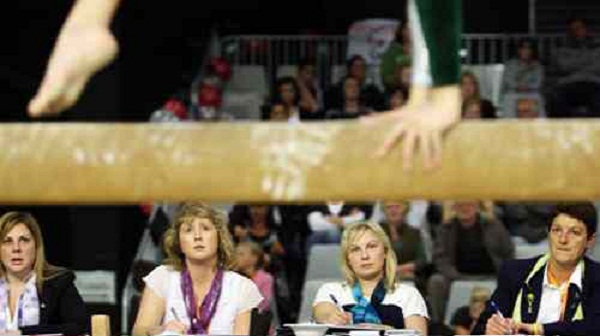
I’ve had aspirations of being a gymnastics judge for as long as I can remember. I’ve always been fascinated with the construction and evaluation of a routine, and with the process of how judges turn performances into scores. After I graduated from college, I was lucky to be hired as a coach at a gym where a highly respected and experienced judge was also employed, and she helped guide and mentor me until it was time to take my judging exams.
Even with 16 years under my belt as a competitive gymnast and an insatiable obsession with anything gymnastics, I couldn’t have anticipated what the next few years would hold as I navigated my way through the judging world. There are some things people just don’t tell you about gymnastics judging.
1. It’s intimidating.
I think there are a lot of people out there who have an interest in judging, but are too intimidated to get started, and this is something I can wholeheartedly sympathize with. I live in a small state, and nearly all of the judges in my state judged me as a compulsory, optional, and yes, even collegiate gymnast. When nearly everyone around you has anywhere from 10-35 years of judging experience and you are fresh out of college, it’s easy to be intimidated. I was terrified that they were going to think I was stupid or unworthy somehow. My fears were not realized. In fact, the opposite happened. I was welcomed and encouraged. My questions were answered with kindness, not hostility. When I thought I was going to be on the outside looking in to an exclusive, elite club, I actually found that my judging colleagues welcomed and embraced my youth and perspective.
2. There’s an overwhelming amount of information.
I’d like to think that I had a good foundation of gymnastics knowledge prior to judging. I competed as a level 9 and as a Division III NCAA gymnast, so I had a good sense of skill values, bonus values, and basic deductions. My teammates would come to me with questions because they considered me almost like a walking Code of Points. So naturally, I figured that judging would be a breeze, right? Wrong! I was shocked at the sheer volume of things I didn’t know and had to learn to pass my exams. Judges need to be well-versed on rules and policies, requirements for each level, skill values, hundreds of deductions, angle requirements, and so much more. Merely knowing them is not enough; you have to be able to apply many of them at once in a moment’s time, without missing a beat. Judges can’t hit the pause button on a routine so they can catch up, nor can they hit the rewind button if they missed something. It takes a lot of brainpower and focus to be able to watch, analyze, and record the skills and deductions of a gymnast as she does her routine.
3. You’re not going to be ‘right’ all the time.
The allowable range of scores exists for a reason. As a former gymnast, I am a natural perfectionist. When I would judge a meet and my score differed greatly with the other judge on my panel, I would panic. What did I do wrong? Did I miss something? The reality is that when two judges come up with scores of 8.3 and 8.8, they are within range. The average score is an 8.55, which is likely exactly what the score ought to be, and as a result, neither judge is right or wrong. Gymnastics is a subjective sport, and while the goal for judges is to remain objective and impartial, no human being is 100% objective and impartial. Every judge has his or her own taste and style preferences; different things they are tough on, and different things they are more relaxed on. Just because you aren’t within two tenths of your chief judge doesn’t automatically mean that you’re “wrong.” This is something that the perfectionist inside me still struggles with, and so I have to constantly reassure myself otherwise.
4. People look at you differently.
When I walk into a meet, most gymnasts look at me with a strange mix of awe, reverence, and fear. Judges hold most of the power in gymnastics. Their judgments determine the outcomes of meets. We make little girls cry and adults protest (That judge gave my daughter a 7.9? Who does she think she is? She obviously has no idea what she’s doing!) As a result, most gymnasts (especially the younger ones) find judges to be both mysterious and terrifying. The thing is, I’m a coach too. I attend some meets as a judge, and some meets as a coach, and when I am wearing sneakers and leggings, people don’t look at me the same way they look at me when I’m wearing a blue suit, but I’m still the same person.
5. Perception is everything.
Gymnastics is a subjective sport, and it’s very difficult to understand as an outsider. Many parents have no idea how judges come up with scores or why their child received the score they did. We don’t just eyeball the routine and pull numbers out of a hat. It’s much, much more complicated than that. Judges are often seen as heartless curmudgeons who are hell bent on purposely underscoring performances, and that simply is not true. I don’t score gymnasts low on purpose, and a friendly smile to a coaching friend does not mean that I’m in cahoots to give their gymnasts higher scores. But when parents are watching you and trying to justify why their daughter’s score was lower than another girl’s without basic fundamental knowledge of how routines are scored, they will find any and every reason to blame the judge and their supposed impartiality.
6. You never stop learning.
I’m constantly learning new things, whether it’s a new shorthand symbol (I haven’t quite mastered the mysterious “judginglyphics” yet) or a new way to determine amplitude angles. I think that the fact that someone can be heavily involved with gymnastics for the majority of their life and still learn new things about it speaks volumes about the vast and intricate depth of our sport.
7. Never be afraid to be yourself.
Being a judge doesn’t mean that you have to be stern and stoic all the time in the name of professionalism and impartiality. I think it’s important to be yourself to remind gymnasts, coaches, and spectators that you are a real person and not a robot. If as a judge, you had previous experience as a gymnast and/or coach yourself, it’s important to remember and honor that perspective as you judge. And of course, what would staying true to yourself be if you didn’t make that drab blue uniform a little nicer by sporting a brightly colored pair of high heels as you strut into the gym?
8. It’s a whole new way to enjoy gymnastics.
I love gymnastics. I’ve always loved gymnastics. I love doing it, I love coaching it, I love watching it. But judging allowed me a new way to love gymnastics because it gave me a perspective I never had before. I have a deeper appreciation for the technical side of gymnastics, and I love the feeling of watching a beautiful routine and having the ability to reward it with a (well-deserved) high score. Despite marathon judging sessions that make my head spin and my hand cramp, becoming a judge was the best professional decision I ever made.
Article by Sarah Chrane


I think it’s worth driving home the point about perception in #5 especially when it comes to arm-chair judging by video/TV versus judging in real life. It’s amazing how different gymnasts and their skills look just from a few feet away.
I know a lot of fans (who claim to know the COP) think they can judge better than the actual judges, but they seem to forget that they have the luxury of video, being able to stop, pause, and replay at their disposal. Judges don’t have that luxury except when they need to review elements in question with regard to D-score. The E-scores generally don’t change unless someone is absurdly out of range. Take into account that the judges have to watch gymnasts go through their routine, write down the skills while marking values, connections, and deductions, all without a break. It’s easy to miss something when you look down.
LikeLiked by 2 people
Then they should come up with a more adequate system to make it accurate, not admit its a tricky business, and leave it as it is with controversies and bitterness plaguing the sport. Allow the e-panel to have a tablet at their table with instant playback, research what is actually the best vantage point for judging each apparatus (maybe its not where they’ve been placed for the last 50 yrs, maybe they shouldn’t all be sitting together even),figure out who should be writing down the skills and who’s in charge of watching. Gymnasts work their asses off and deserve to be graded fairly. The least the FIG and its judges could do is fix the flaws if there are practical reasons why it’s not. No matter how tough they say the job is, they are not the hardest working ppl in that arena.
LikeLike
Pingback: Is Gymnastics A Sport? Debunking Myths and Misconceptions