It’s time for the 36th edition of You Asked, The Gymternet Answered! We apologize if we haven’t gotten to your question yet, but we try to answer in the order in which they were received. Something you want to know? Ask us anonymously by going through the contact form at the bottom of the page.
What is the typical elite D-score range for top NCAA gymnasts? Any word of Bridget returning to elite?
It’s hard to say for sure, because NCAA routines are constructed differently than elite routines, using different requirements and rules (i.e. their dismounts aren’t usually difficult enough for elite to meet the D dismount requirement…you see a lot of gainer fulls or layout fulls). They also don’t usually have enough elements to reach a very high elite difficulty (like, you count the 8 highest elements in elite and most tend to be in the D range, whereas NCAA gymnasts might count 8 elements total with only one or two of a high range).
I played around with Ivana Hong’s just to get an idea, and hers fulfills all requirements but the D dismount, so she’d lose 0.2 from the composition requirements, starting her out at 2.3. She counts 9 elements, and her 8 to count would be DDCCBBAA giving her 2.0 in skill difficulty, and then her only connections are her Onodi to bhs (no bonus), a bhs to loso (no bonus) and a split jump to sheep jump (no bonus). Ivana’s total elite difficulty for her NCAA beam would be 4.3, and she has one of the more difficult routines.
Most top NCAA gymnasts are going to be somewhere in the 3.5-4.5 range on most events depending on how much “extra” they put into their routines, partly because of missing element requirements. Aside from vault, of course…they pretty much all do FTYs, so they’d get a solid 5.0 there. Someone like Ivana, who goes above and beyond by doing D skills like an Onodi and a sheep jump, will have a bit more than those who stick to the more basic elements and don’t include any Ds in their routines.
As far as I know, Bridget has no plans to return to elite and isn’t training with elite in mind.
How did Ragan’s back full on beam get credited in Jesolo, did they give it layout or pike?
We don’t actually know because we don’t have access to the judges’ worksheets, but I believe I remember a coach saying she was given value for a pike (since that’s what the element is).
I’ve always been curious why some gymnast wear odd, almost sock like (but they look bigger, with holes for toes) things on their feet during training. What are they and why do so many gymnasts use them?
They basically give you a better grip on an apparatus (kind of like chalk). Gymnasts with excessively sweaty feet sometimes slip on beam so it can help there, they help gymnasts get turns around on floor, and some have a little padding so they can help with skills that pound their feet. You typically see them on beam and floor, but some wear them to vault as well. Some are kind of like ballet shoes in their style, and then others wear just the half shoes which are like the foot undies or dance paws lyrical dancers wear. Dancers need them more because they tend to perform on hard surfaces (i.e. hardwood stages), and that’s actually why beam shoes existed for gymnasts – the beam used to be wood and they needed the cloth material to help them execute elements. Now that beam is padded and has a suede covering, they’re not super necessary, but some gymnasts will prefer to wear them because of that extra grip or traction.
I saw a gif of a really cool skill done by a Russian junior at nationals: double turn in tuck stand straight into a double turn (with leg below horizontal). Do you know the name of the gymnast?
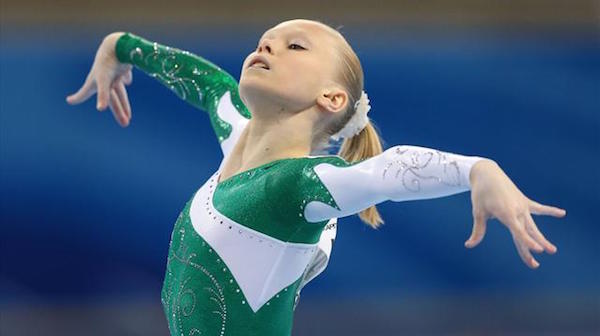
Yes! That is Angelina Melnikova, the 2014 junior European champion. She becomes a senior next year and is a tremendously talented young gymnast. Here’s a video of her floor routine with the double wolf turn to double turn.
Do you know what Teal Grindle (GB) has been up to? I was sad that she wasn’t at the British Championships, do you know if she is injured or something?
Teal has a shoulder injury and I believe hasn’t competed since last year’s European Championships. We hope she will be feeling better and back in contention next year!
What makes the U.S. so dominant? Is it just resources, coaching, and the Karolyis? I’m sure there are young people with the potential to be great gymnasts in every country, so why is the U.S. able to produce so many more consistently great gymnasts?
It’s a combination of many things, including everything you’ve mentioned in addition to the national team program and developmental programs. There’s also the fact that NCAA scholarships exist as a ‘reward’ for gymnasts who make it to the top of the J.O. levels, so you have thousands of gymnasts who reach a level that maybe 50 gymnasts max reach in other countries.
These level 9 and 10 J.O. gymnasts aren’t even elite yet could probably whip together basic elite routines that would make them top contenders in smaller international programs, and they’re pushed to continue training at a high level until their early 20s despite not being on an elite track, whereas once gymnasts in other countries reach age 13-14 and national directors see that they will not do much on the elite level, they’re essentially put out to pasture.
The U.S. developmental program is a centralized program without even being really all that centralized, in that gymnasts don’t all come to live and train at one big center like Round Lake or Deva or whatever but they’re still essentially working on the same foundational skills through TOPs and J.O. competition. Each gym and coach takes the training and coaching into its own hands, but they’re following a system that they have to follow in order for their gymnasts to reach the top levels, and that really makes a difference in the U.S. program as a whole.
Most J.O. gymnasts won’t go on to become elites, but those who do all came up through the same system and then continue to follow the same elite path, meeting compulsory requirements and national qualifying scores…it’s a system that works!
The U.S. is also helped by the fact that the open-ended scoring system allows them to take that development system to the next level by pushing superb difficulty thanks to strong basics, and they also have a huge pool of athletes to choose from (partly because the population in the U.S. is so immense, but also because the U.S. has a large population of people with the money to send their daughters to the top coaches even if it means moving them across the country).
So yes, there are many reasons, and everything kind of works together to make them a top program.
Have a question? Ask below! Remember that the form directly below this line is for questions; to comment, keep scrolling to the bottom of the page.


Article by Lauren Hopkins
Photo is Angelina Melnikova of Russia
 The Gymternet
Yay for the Melnikova question (and answer and vids!). Definitely wish she was a senior this year. I miss the old rule of 15 year olds competing as seniors a year before the Olympics
LikeLike
Sorry if I am mistaken, but I don’t think Ivana’s beam elite difficulty is calculated correctly in the article. Her NCAA routine is as followed:
Press to Handstand Mount (B)
Onodi (D) + BHS (B)
BHS (B) + LOSO (C)
Spin (A)
Split Jump (A) + Sheep Jump (D)
Gainer Pike Off End Dismount (C)
She would receive 2.3 from composition requirements (0.3 for C dismount). The counting skills would be:
Acro: BBCCD
Dance: AAD
Total score: 2.3 (CR) + 0 (CV) + 2.0 (DV) = 4.3
Anyway, as always, thanks for this article and all your hard work! 🙂
LikeLike
Thank you! I forgot to give her the 0.3 back for the C dismount and just gave her a 2.0 CR instead of a 2.3.
LikeLike
Thanks. I’ve always kind of wonder what kind of SV NCAA routines are…anyway, I am not one who miss the 10 pnt old scoring system. The new one is much better IMO as it clearly shows the degree of difficulty and distinguish each gymnasts routines. The 10 point old scoring system does not distinguish difficulty enough. As the result, no one cares about upping the difficulty of the routine. I bet if NCAA were to adopt elite COP, the SV would skyrocket overnight, although I am not advocating this by any mean.
Also related to the last question, the US undoubtedly knows how to take advantage of the open end COP and run away with it. But they don’t just do that at the expense of execution as their execution score is still top notch in competition. The great number of top gymnasts does really help (quantity is a quality in its own as the saying goes). Also the diversity of gymnasts (body type) as well as the diversity and large number of coaches (from various nationalities with various training specialization and perspectives) helps. Having the financial resources (corp sponsors national level and parents at grassroot level). It’s basically a combination of many many things which is why there’s only a handful of nations that have top notch programs…
LikeLike
Pingback: Melnikova – double wolf to double turn | Excellent Liquid Chalk for Weight Lifting
How can i purswade my coach to let me wear socks to gym x
LikeLike