It’s time for the 37th edition of You Asked, The Gymternet Answered! We apologize if we haven’t gotten to your question yet, but we try to answer in the order in which they were received. Something you want to know? Ask us anonymously by going through the contact form at the bottom of the page.
I was wondering do you know what Evgeny Marchenko is up to? Is he still coaching? The only things I hear out of WOGA are Laurent Landi related.
He is still coaching! One of his gymnasts, Ava Verdeflor, actually represented the Philippines at the Youth Olympic Games last summer and Evgeny was right at her side the whole time. He’s not coaching as much as Laurent/Natasha, who seem to be running the show coaching-wise, but is more in a non-coaching ownership role like Valeri Liukin.
I was wondering whether you know what specifically Steve Penny does? Does he have any say in selecting teams or choosing members of the selection committee?
As the president of USA Gymnastics, he isn’t really directly involved in the women’s program and isn’t on the selection committee, so doesn’t have a say in selecting teams. That said, he definitely has influence over the program from above and I know of a few decisions he has been a part of. He is coming at everything from more of a business standpoint than a team strategist, however, so it’s tricky because things that work in terms of bringing viewers or money don’t work as well for the team, so I think there’s a balance that the women’s program tries to find between the two (with the emphasis on what’s best for the team).
How do you pronounce Nguyen?
It’s pronounced like “win” and is actually the most common Vietnamese surname!
Is there any reason other than tradition that the women compete in leotards? I feel like I see pictures of gymnasts training in regular workout clothes all the time, so it doesn’t seem like it’s functional.
It’s always been my understanding that leotards help judges see your body line and correct form better than any other piece of sportswear, and most are made to help with aerodynamics (like a swimsuit) in addition to being flexible and breathable enough to allow for packed routines with crazy skills. Leotards have been the go-to because younger girls in the sport may not be comfortable competing in the more revealing workout clothes (like sports bras) but also can’t compete in tank tops and shorts just because it wouldn’t be practical. A stretchy one-piece just makes more sense.
Leotards are basically like an outer layer of skin, so they allow maximum movement and performance without hiding your form. With many skills, your leg form starts at the hip, so a more high-cut leo is better than a pair of shorts because your entire hip/leg is visible. I guess the sleeveless vs sleeves is more about tradition, though. Typically it’s thought to be ‘unprofessional’ to wear sleeveless leos in competition, though they’re what pretty much everyone works out in.
I thought that the field for the American Cup was normally 8 gymnasts for each gender. Do you know why there were 9 this year?
Sometimes the FIG gives two spots to the host country even if the host country doesn’t have two in the top 8 or two who accept their spots from the top 8. So when Simone accepted her spot but Kyla denied hers, the FIG still had to go down the line of top gymnasts at Worlds, but then also offered a second spot because the U.S. was hosting. I believe 9 were also invited to the World Cup in Glasgow.
Can you explain the team competition format for Jesolo? I noticed that the USA had listed 10 seniors as attending. Did they have 2 teams compete? Were some of the girls sent as reserves?
The U.S. typically sends a ‘team’ and then ‘individuals’ to compete at Jesolo, with the strongest athletes usually on the ‘team’ and then everyone else competing in a mixed group. The U.S. this year ended up using 7 on the team and 3 as individuals, but the 3 not officially on the team still get to accept the team trophy with the girls on the team, and they’re eligible for event finals just like the team is.
Because Jesolo isn’t an official FIG competition and is more of a friendly meet, the organizers don’t follow any sort of competition rules which is why there is more flexibility with teams like this. This year, they allowed the U.S. (as the defending champions) and Italy (as the host country) to automatically compete in finals. Canada, France, and Australia had to compete in qualifications, the top two teams there got to qualify as teams into finals, and then individuals not from qualifying teams got to compete as individuals in team finals, which also acted as the all-around final as well as the event final qualifications. So the Saturday competition was a combination of TF, AA final, and EF qualifications, if that makes more sense, and Sunday was EF day.
Thanks so much for this series! I wanted to ask about controversies over USA gymnasts’ well-being over the past couple of decades. There are, of course, all of the horror stories from the 90s–anorexia, abuse, stunted growth, etc. Did these issues end with the ‘pixie era’? Do the coaches do a better job of making sure the girls are healthy, or is this just something we don’t hear about anymore? Comparing the current elites to those of the 90s, I feel like they look healthier and more relaxed, and more like “normal” young women–do you think this is the case? Do you think there has been a shift in the predominant body type for elite gymnasts?
You’re welcome! I think once people began looking into accusations of abuse in the 90s, the culture of that time changed a lot. You had gymnasts going on Oprah and other talk shows to discuss abuse and weigh-ins and other shady practices in gyms, giving quotes to major newspapers about Bela screwing them over in 2000, writing books, etc. Once the public catches wind of this, things start to change, and it really all started with Bela being denied access to the women’s program while putting USAG more in control in terms of not letting the national team coordinator have all of the control.
Martha Karolyi clearly runs the show but since 2001 there have been so many other people in place, so her power is not unchecked. There were also many more rules and regulations put into place regarding athlete safety and everything, and there are athlete reps and boards and committees all in place to make sure things are run with the athletes’ best interests at heart. It’s not always a perfect system and there are definitely instances of gymnasts who might be pushed further than they are physically or mentally capable of performing, but overall they’re incredibly healthy. I think also the difficulty level has grown in a way that you need to be healthy and strong to compete well, so that muscular body type is more accepted than it was by coaches and judges before and during the 90s. Girls deprived of food and lacking in muscle just can’t compete as well under this code as girls who are more physically fit.
Obviously you still have different body types in the sport and not everyone is going to be as solid and jacked as Simone Biles, but even the girls who are naturally long and lean still have a great deal of muscle, and those who don’t tend to suffer a bit more and can’t keep up. So definitely the nature of the sport and what it requires from its athletes has helped in addition to the changes the U.S. program underwent after the 2000 Olympic Games.
Have a question? Ask below! Remember that the form directly below this line is for questions; to comment, keep scrolling to the bottom of the page.


Article by Lauren Hopkins
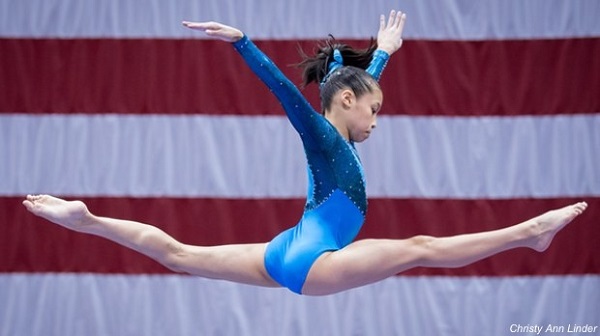
Photo is Victoria Nguyen of the United States


Thanks so much for these posts! I’m not involved in gymnastics in any way (apart from watching videos and reading things online) and these are extremely interesting and informative! I found your answer about the leotards especially interesting as it had been something that I had wondered about myself 🙂
LikeLike
I have wondered why men wear shorts etc. in competitions but women don’t wear them. If it is important to see body lines in artistic gymnastics (at least women) why it is not important to men?
LikeLike