It’s time for the 85th edition of You Asked, The Gymternet Answered! We apologize if we haven’t gotten to your question yet, but we try to answer in the order in which they were received (unless they are super relevant and need to be answered in a timely manner). Something you want to know? Ask us anonymously by going through the contact form at the bottom of the page.
Do you have any news about Catalina Ponor or Sandra Izbasa in their comebacks?
You may have heard Catalina is back in action and doing well, debuting at Doha over the weekend and earning a 14.65 for both of her beam routines. There’s still some room for improvement in her execution there, though unfortunately for the time being she won’t be able to contribute anywhere but beam due to the leg injury sustained last fall. Sandra Izbasa decided not to come back after getting back to the gym but realizing she wasn’t going to be anywhere near the level she was used to, thinking she wouldn’t be able to contribute anywhere…though honestly with the way the team looks at this point, I’m wondering if she’s like, darn, I should’ve done it?!
What do you think the odds are of having four of the 2012 Russian team representing Russia again this year?
Pretty high unless they’re injured, I’d say. Valentina Rodionenko has said that Aliya Mustafina, Viktoria Komova, Ksenia Afanayseva, and Maria Paseka are confirmed for this summer’s team, with the last spot between about seven of the younger gymnasts, including Seda Tutkhalyan, Daria Spiridonova, Evgeniya Shelgunova, and the four top new seniors (Angelina Melnikova, Natalia Kapitonova, Daria Skrypnik, and Ekaterina Sokova). I’m leery about Mustafina being called a lock, as we haven’t seen her compete in nine months and she is reportedly not fully ready yet, so you have to wonder if she can get it together by August. But the other three all looked great at worlds and should be great contributors this summer…so yes, I think it’s definitely likely that at least three of them will be in Rio with four as a possibility!
Do you know exactly what Norah Flatley’s injury is and how long she is out?
I haven’t heard what the exact injury is, just that she was training up until she got the surgery and that it was a minor surgery, nothing that will keep her out for the year or anything. I also heard she was only doing bars and beam prior to the surgery, so I don’t know how competitive she’ll be given that she’s missing extended periods of training time.
Thanks for your great insight! Can you clarify why Romania’s all-around spot at the test event would be non-nominative but Belarus’ would be?
Basically if a country with multiple gymnasts at the test event (i.e. one of the eight nations there with a full team of six or one of the eight nations there with two gymnasts) qualifies an individual, the spot earned goes to the country, not the gymnast…but if a country is represented by a single individual, the spot is the gymnast’s.
So if Romania or Switzerland don’t qualify a full team, they will earn a single gymnast spot as a country. The same goes for a country with two gymnasts there, like Mexico or Sweden…it doesn’t matter who gets the higher score, the spot belongs to the country (like in 2012, Elsa Garcia earned the spot for Mexico with the higher score at the test event, but for a while it looked like Ana Lago might go because Elsa was injured, and Daria Elizarova earned the spot for Uzbekistan but Luiza Galiulina ended up being the one selected to go…and then got banned like two weeks beforehand for testing positive for a banned substance).
Compare this to a country with a single gymnast. If Kylie Dickson goes for Belarus and earns that spot, the spot belongs to her. If she for whatever reason can’t compete, it won’t go to another girl from Belarus…it’ll go to the first reserve, aka someone who competed at the test event who missed out on qualifying.
Regarding floor music, why can’t gymnasts use songs with lyrics? What is the reasoning behind this? I know the CoP allows vocals if they “have no meaning” but do you think gymnasts should be able to use whatever music they like?
I think it’s because lyrics – as in words – tend to act as cues during routines, like “on this word, I do this bit of choreo or this split leap” if that makes sense. Without lyrics, it becomes more difficult to take those verbal cues. I don’t know if that’s exactly why the rule was created but that’s how coaches have talked to me about the rule in the past. Anyone else who has more experience with this, chime in! I’d personally actually love music with lyrics for like, five minutes…but then I think it would get really annoying REALLY FAST because you know people would like, scream along with the lyrics or something. Might be fun for NCAA…a girl does the music from the song “Tequila” as her floor routine and when it gets to that point in the song where you’re supposed to yell “TEQUILA!” everyone in the crowd yells it. Just really fun. But yeah, I can see that getting super distracting at the elite level.
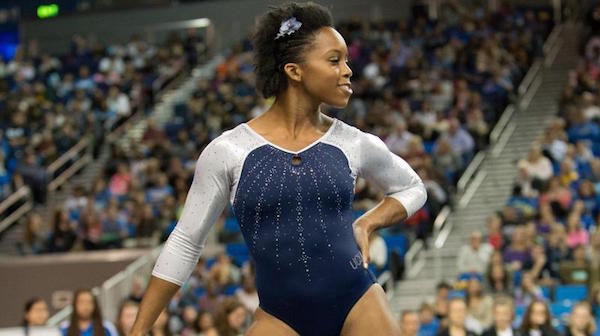
Why does UCLA’s Sadiqua Bynum do two double tucks in one routine?
One is a side pass (aka not done from corner to corner in a diagonal) done on its own and the other is a front tuck through to a double tuck. In NCAA, you are allowed to basically do the same pass twice if it’s done differently. Like, for example, I think Alabama has a couple of routines with like, a back 1.5 in one pass and then a back 1.5 to front layout in another pass. Even though the 1.5 is the same in both passes, because it’s done differently each time, it’s technically not considered the same skill. That’s how Bynum gets around it.
What happened with Alex Waller from UCLA? Why isn’t she on the roster this year?
I don’t know specifics, but I’m guessing she retired? I believe she was a walk-on and she only ever exhibitioned as a freshman and sophomore. Often, walk-ons will retire before they reach their senior year if they don’t end up being real contributors to the team, though they’ll still hang out with the team and attend meets as team managers or assistants. I think she just kind of phased out the way many walk-ons tend to do.
Why are the national team camp results kept so secret?
I don’t think it’s so much about keeping them “secret” because so many coaches and athletes post their own results or rankings, so there’s no rule that’s like “do not share these under penalty of death.” But I think because it’s not a public competition, the women’s program doesn’t have an obligation to publish them officially in the way they would with classics or nationals. Most countries don’t publish the results from internal competitions or verifications or team selection control meets…actually, I can’t think of any that make their results public, except the Netherlands when they had their selection meets last year.
Do you think it’s time the NCAA does something about the ridiculous scoring differences? It makes me sad to think how hard it must be for schools without big superstars getting low scores for doing the same routines other schools are doing.
I think there’s so much messed up with the NCAA system, but the coaches are adamant about not wanting an open-ended scoring system (though in this case, that wouldn’t help much with the disparity between big and small programs if only because the big programs will have all of the big difficulty routines so they’ll keep on winning). In every sport, there are top teams and weaker teams, and there are clear differences between how the gymnasts at Florida or Oklahoma look compared to the gymnasts at, like, Ball State or Arizona State, for example. That’s just the nature of sports…the stronger athletes continue to gravitate toward the stronger programs, keeping them strong and keeping the weaker programs weak. Even though all schools may be doing the same routines, there is a difference in performance level at times, though there are definitely standouts in smaller programs with great technique who earn scores that rival gymnasts from the top schools.
Everyone complains about “Florida home scoring.” Are the judges used during meets in Gainesville the same at every home meet? Aren’t the Gators just that damn good?!
Well, the Gators are pretty damn good. Some of the best, in fact! But other teams can also be considered “some of the best” right up there with them, and yet they don’t stand a chance against them when competing at Florida because Florida’s judging is out of control. Sometimes the judges are the same, sometimes not…I’m not sure how or why it happens, whether there’s pressure from the athletic department or something, but some routines are definitely overlooked in terms of faults, as if the judges go temporarily blind or something. It’s not just Florida, the SEC tends to be a bit generous at times with specific gymnasts, but Florida always stands out as being at the receiving end of the generosity year in and year out.
Like, at SEC Championships in Arkansas this year, Florida’s final competitor had a significant landing deduction in her final pass in addition to several other deductions throughout (many noticeable). It shouldn’t have gone above 9.8. One judge gave it a 9.95. In the end, with all judges combined, it averaged a 9.875 which was 0.025 above the score they needed to win. Really? That’s pretty magical for them. I love Florida as a team (nothing broke my heart more than their NCAAs loss in 2011) and I love pretty much all of their gymnasts, but their judges, I don’t know. They allow them to get away with a LOT of nonsense. It’s the nature of NCAA and I try not to complain about it with them or other programs with similar nonsense, but I find myself outraged when some of that bad judging ends up leading to meet-deciding tenths, as it did at SECs this year.
What does an individual gymnast have to do to qualify to the Olympics from the test event?
First you should know that 98 female gymnasts overall will qualify to the Olympics. Of these, 60 are on the twelve qualifying teams, leaving 38 spots for gymnasts. Of those 38 spots, two are currently taken by event medal winners from last year’s worlds, Hong Un Jong and Pauline Schäfer. Should Germany qualify a full team, which they’re likely to do, Schäfer’s automatic individual qualification goes back into the pool, bringing it back up to 37 open spots.
THEN there are three spots that go to gymnasts from weak programs, including two universality spots and one tripartite spot. The universality rule states that every continent must be represented by two gymnasts, so this rule benefits Africa, which only has one potential contender at the test event, Farah Boufadene. Whether Farah earns a spot or not, Africa will still get two spots in Rio. The tripartite rule allows for a gymnast from a country at last year’s worlds that has qualified six or fewer athletes at the last two Games, so someone from Bolivia, Cayman Islands, Malta, or Moncao will get this spot.
With those out of the way, we’re now down to 34 spots for individuals. 37 nations will contend for these 34 available spots, including the four nations that don’t qualify a full team and 33 representing as individuals. As an individual, you basically have pretty good odds, with only three nations represented at the test event not moving onto the Olympics (and if Farah Boufadene qualifies for Algeria on her own merit rather than eating up a universality spot, only two nations won’t move on to the Games). Individuals must compete in the all-around, but there is no magic score to reach. As long as you rank so that you are ahead of those two or three gymnasts who don’t make it, it doesn’t matter if you had a 56 or a 46 all-around. You’re still going.
Have a question? Ask below! Remember that the form directly below this line is for questions; to comment, keep scrolling to the bottom of the page.


Article by Lauren Hopkins
Dedicated to Jeanine
 The Gymternet
Another thing about the test event…some countries might qualify but then the national federation will decline the spot because their athlete isn’t competitive enough. I think this was the case with New Zealand in 2012 and Veronica Wagner in 2008. Any chance of this situation happening again this year?
LikeLike
It could but with New Zealand in 2012, they actually didn’t initially qualify a spot and only ended up getting a reserve spot, but they didn’t take it because it was too last-minute and they didn’t have anyone competition-ready. The Wagner issue in 2008 was definitely unique and I don’t see any country currently sending a gymnast to the test event doing something like that, but you never know what could happen as the Olympics get closer. If their athlete deteriorates greatly between the test event and the Games, then yes, they could pull them, but as of right now I can’t see anyone doing it for no reason.
LikeLike
I personally prefer music without lyrics, but the part about the cues doesn’t make sense to me because gymnast can also work in cues in instrumental.
LikeLike
Verbal cues are 900% easier to recognize than music. It’s why NCAA gymnasts love when they’re able to use beam music – the lyrics help them define their choreo and mark out the routine. Music cues obviously have to exist otherwise floor would be a mess, lol. Like, lacking any sense of rhythm like most beam choreo. But lyrical cues make it so much easier to emote, express, hit marks, etc. I can think of maybe five NCAA and elite gymnasts who fully perform to lyric-less routines in a way that you can tell they actually know what they’re doing. With lyrics giving cues for both the choreography and expression, that number would multiply by so much because lyrics make it that much easier. When I say cues I don’t mean just like “oh she said the word LOVE and that means I pose in the corner!” They can do that now with the random OOHS and HEYS in routines. But performance cues are another story and lyrics absolutely make it easier.
LikeLike
Ok. Thank you for clarifying!
LikeLike
I’d always assumed that the lyrics rule was so the judges wouldn’t get distracted listening to the lyrics, or pre-judging the gymnast for her lyrics choice. Thus gala and exhibition performances in figure skating and gymnastics can have lyrics, while competitive performances don’t.
LikeLike
I was under the impression that it was to prevent having to have a rule about “offensive” lyrics and then having to have translations and 32458043 semantic arguments about what constitutes “offensive” at every meet of every quad. When gymnastics first moved away from piano-only floor accompaniment, no singing was allowed in the music at all; I think it’s only been in the last decade or two they changed that as computer generated accompaniment has become more common/accessible – by which point that rule would definitely have been relevant if lyrics were allowed. (Not to mention, if you take a normal length song and cut it down to the 1-minute 30-seconds allotted for floor, lyrics-wise you’re liable to get something that doesn’t naturally flow anyways. No lyrics just makes it easier on everyone.)
LikeLike
Just wanted to leave a comment about the judging question. The judging assignments *are* randomized, but they’re regional. No judge is going to travel too many hundreds of miles for a regular weekend meet. I could think of a couple small ways to ensure certain judges at a certain meet (ie. making sure all the other available judges say they aren’t available that weekend, or reduce the number of miles they’re willing to travel depending which school they’re at). …BUT…. Even if they did cheat the system at times, there is still a rule that no judge can see the same team more than four times a season (but only 2 times at home, 2 away), to make sure that no judge sees a team too frequently. So, to those who think this, it’s not “Florida’s judges” or “LSU’s judges” — they are randomized and can’t even see them even more than two times at home.
That doesn’t keep them from buying in to incentives to score higher or overlook deductions bc they like (or dislike) a certain athlete. Yet, even though the SEC is known for the craziest scoring, teams that go frequently go outside of their region for meets are coming into entirely different batches of judges, but still see the same discrepancies. The PAC12 has rivaled their absurdity this year. …both too high AND extreme low-balling. There’s definitely a problem, and as a former judge myself, it makes me CRAZY watching any meet — but esp when I see a near-fall/three-tenth wobble on beam with a foot shuffled landing still score a 9.9. A small check on every skill still averaging a 9.95. Or a floor routine with obviously uncontrolled or LARGE lunges on every pass still getting a 10 from a judge. Or Ebee, Nina, and AJ Jackson doing some of the most flawless performances ever seen nationally all year and finding themselves with low nines.
In the context of Bridgey Caquatto, I could see how maybe like one or two of the four judges could’ve missed the deductions of the first wonky pass (or at least the severity of it) based on their angle. And this is where I can understand SOME of the constant discrepancies. It really is crazy what a routine can look like from a stationary spot, (esp looking up if on podium), and the gymnast traveling so far away from you. (It’s not at all like when camera’s follows a girl or changes angle quick as she runs into the pass to view it from the side. I mean how many times do you watch a routine and think “Oh man, idk what they’re gonna do with that, lemme wait til I see it it again from a diff angle to make my opinion. …couldn’t see it too well from that angle.” But the judges don’t get to see it again at all, let alone a diff angle. So that does make a difference in this crazy scoring.) But there’s NO excuse for missing her final landing deduction, and they ALL should’ve supplied scores around the 9.85 mark for just that, lower if they had a good shot at the other areas. A 9.95 wasn’t even given to the most flawless routines of the day — there’s no reason any ONE of them should’ve come up with that total, no matter where they were sitting. I worry that, not just inaccurate judging is happening…. but a mindset of “This is going to be averaged….I know that so-and-so judge goes really low, so if I go low too, I can’t bring her score up to a better more acceptable number. So I’m gonna go really high just to get it where it should be.” …and then three of the four doing so. (Or just the one in regular meets.) Heck, even in club, I know I was guilty of this mentality every so often. I thought of myself as a very ACCURATE judge and prided myself on being detached emotionally and very specific with my deductions regardless of competitor, team, body shape, or gymnastics style. That often made my scores lower than what the older or new-mom-age “hey, these are just fun level 6s, who cares” judges could be like. But every now and then I’d be paired with a REALLY strict old-school judge and knew how much I hated flashing mid-9 scores for some of the BEST athletes. So, knowing I had a two tenth leeway then, I’d find myself tallying up my numbers after the routine completely and pausing to review individual skills I could be a little more lenient with JUST so I could try to pick their number up a little bit. (…but I know I particularly had to do this if they were overweight or unattractive since I knew that this judge HATED those kinds of gymnasts and was extra cruel on them). That mentality and judgment and mind-game playing is SO unfair and yet I still found myself “counter-judging” for someone else’s unfairness. And instead of just being honest, I think a lot of that happens… this “counter judging” what you think the other judge is going to do with a routine/certain athlete instead of accurate judging based on skills completed. Heck, I even remember feeling embarrassed if I turned in scores that were way too NICE compared to theirs bc I felt nervous the other judge would think I didn’t know the code or something after it would happen a few times in one meet. So, all kinds of stupid stupid stupid shit can influence a judge. Clearly. And then, of course, theres the standards with all types of favoritism, blinders, and prejudice.
But I did at least want to comment that the judges’ assignments *are* randomized, they don’t belong to or frequent any one school, and that they can only see a certain school a few times a season, annnnd they aren’t paid BY the school to come and aren’t allowed to accept anything from them.. But hey, the schools DO provide accommodations for their stay, and if Florida and LSU and UCLA are all boss with how they put up their judges??? You could see some inflation just there just based on the fact they were treated like royalty instead of kept in a back room on metal fold-out chairs. But damn, something needs to be done. Cuz it’s baaaaad.
LikeLike
Interesting… at the D1 school I work at, there’s a pool of conference judges, but the school selects AND pays for the judges when we host a meet. It may differ depending on what conference the school belongs to, and if its a regular-season dual meet or an invitational, but the school (realistically the coach) is in charge of who judges.
LikeLike
As a long-time gymnastics fan, with little understanding of exactly how the judging system works on the college level, I found this absolutely fascinating to read.
The thing I like about elite scoring is from my perspective, it makes sense when you see someone’s D score and E score. When a gymnast totally misses a skill/connection, their D score is downgraded. Similarly, form breaks and the like are taken from the E score. It makes sense to me when comparing a gymnast like Simone, who has insane difficulty and beautiful execution, with a gymnast who may look just as beautiful but is lacking difficulty, why Simone is scored higher. The D/E breakdown provides context for understanding how the gymnasts are scored.
Sometimes I struggle to understand the exact method to scoring in the NCAA, because I see routines from certain gymnasts and feel like they are inadvertently “punished” for not being in a conference like SEC. Or, contrarily, it’s really interesting to see how a team like Florida is judged when they AREN’T in the SEC. I was at the Minneapolis regional last weekend and it was shocking/refreshing to see Florida walk away with a final score of less than 197. Granted, it was not their best meet, and there were still some questionable scores (a 9.9 from one judge for McMurtry’s bar routine being one) but it makes you question just how differently athletes can be scored out of their home context.
LikeLike
I was watching 2008 meets recently, and I noticed that a lot of the UB dismounts used currently are easier than those used in that quad (i.e. full-twisting DLO then vs. tucked full-in or straight DLO now). I’m not the best at interpreting D-scores. Was there a major shift in the CoP that has caused the difference, or is it just something that happened?
LikeLike
Is Emily Gaskins in the mix for Rio? She’s a new senior, but she has a lot of the skills that could get her noticed? Do you think Marta might be considering her?
LikeLike
Not really. She isn’t anywhere near the level of the other girls and probably isn’t even in the top 20 AA if everyone is at full strength. Based on competitions thus far in 2016, Simone, Gabby, Aly, Laurie, Maggie, Ragan, Brenna, MyKayla, Emily Schild, Amelia, Christina, and even Lexy Ramler are all stronger competitors. Then there are those who haven’t done the AA yet or who don’t train all four events who still have a better shot – Bailie, Rachel, Norah, Jazmyn, Alyssa, Madison, and Ashton. She has some unique skills but overall even most of her basics need a lot of work…her technique has gotten incredibly sloppy and her hit routines are scoring in the 12s and low 13s, and her DTY is only getting in the low 14s. It’s nice to see her still trying but yeah, there’s no way.
LikeLike