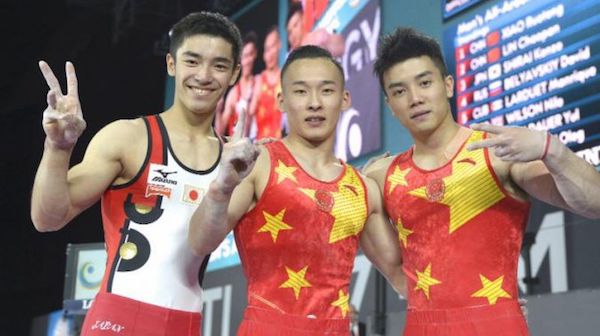
Kenzo Shirai, Xiao Ruoteng, and Lin Chapoan
Now that we’ve actually had a nice, long recovery break in the aftermath of the 2017 world championships (#ISurvivedMontreal), we dive into what happened and how it affects each program’s international standing within the sport.
Basically, it’s still China’s world and we are all just living in it. China actually increased their overall medal count by five, bringing them to nine medals ahead of second-ranked Japan.
With three additional medals, Russia jumped to fifth ahead of Germany, while Great Britain, the United States, Ukraine, and the Netherlands stayed in third, fourth, eighth, and ninth, respectively. While each of those teams earned medals, none earned enough to jump the team ahead of them.
Others with placement movement include Korea (now tied with Romania for 10th), Greece (12th), Croatia (16th), and Israel (22nd). No new teams broke into the picture this year.
| Rank | Nation | Medal Count |
| 1 | China | 56 |
| 2 | Japan | 47 |
| 3 | Great Britain | 22 |
| 4 | United States | 20 |
| 5 | Russia | 18 |
| 6 | Germany | 16 |
| 7 | Brazil | 11 |
| 8 | Ukraine | 10 |
| 9 | Netherlands | 9 |
| 10 | Romania | 7 |
| Korea | 7 | |
| 12 | Hungary | 6 |
| France | 6 | |
| Greece | 6 | |
| 15 | Bulgaria | 5 |
| 16 | North Korea | 4 |
| Australia | 4 | |
| Croatia | 4 | |
| 19 | Spain | 3 |
| Slovenia | 3 | |
| Italy | 3 | |
| 22 | Poland | 2 |
| Cuba | 2 | |
| Uzbekistan | 2 | |
| Israel | 2 | |
| 26 | Armenia | 1 |
| Azerbaijan | 1 | |
| Mexico | 1 | |
| Canada | 1 |
At these championships there were 21 individual medals up for grabs. Here is the breakdown of the medals won by each country in 2017.
| Country | Number of Medals | Winning Percentage |
| China | 5 | 23.8% |
| Japan | 3 | 14.3% |
| Russia | 3 | 14.3% |
| Netherlands | 2 | 9.5% |
| Ukraine | 2 | 9.5% |
| Croatia | 1 | 4.7% |
| Great Britain | 1 | 4.7% |
| Greece | 1 | 4.7% |
| Israel | 1 | 4.7% |
| South Korea | 1 | 4.7% |
| United States | 1 | 4.7% |
The reigning Olympic all-around, floor, pommel horse, still rings, and parallel bars champions competed at worlds in 2017 and repeat performances were expected, but only two were able to make it happen — Max Whitlock on pommels and Eleftherios Petrounias on rings.
Fabian Hambüchen and Ri Se Gwang didn’t compete in 2017, so we knew their titles would be up for grabs, and then we were faced with the surprise of Kohei Uchimura getting injured in the qualification round, opening up the all-around competition to a new face for the first time in nearly a decade after Uchimura dominated the rankings eight years in a row. Kenzo Shirai was hoping to have that crown passed down to him, but China was able to come in for the kill, getting both the gold and silver on the event to start out with two medals on the way to their eventual five.
On floor, Whitlock struggled with one of his tumbling lines, leaving him without the chance to defend his title there, and though Oleg Verniaiev put together a beautiful performance on parallel bars, he was edged out slightly (and slightly controversially) by China’s Zou Jingyuan.
The most surprising champion in 2017 was Tin Srbic of Croatia defeating 2012 Olympic champion Epke Zonderland, who famously caught his Cassina to Kovacs with one arm, still managing the silver, but the mistake cost him in execution in an otherwise messy final leaving tidy, polished Srbic in a prime position to get the upset.
Article by Kensley Behel
 The Gymternet
Great post! Will there be one about the women too?
LikeLike
Was it really controversial at all that Zou won PB over Verniaiev? I don’t remember reading anything about it..
LikeLike
Me neither.
LikeLike