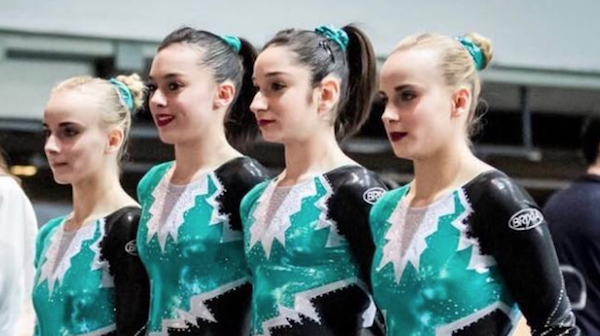
Alice D’Amato, Giorgia Villa, Elisa Iorio, and Asia D’Amato
It’s time for the 270th edition of You Asked, The Gymternet Answered!
We apologize if we haven’t gotten to your question yet, but we try to answer in the order in which they were received (unless they are super relevant and need to be answered in a timely manner).
Something you want to know? Ask us anonymously by going through the contact form at the bottom of the page.
How much of an impact do you think the 2003-born Italian girls will have on the world stage in 2019 and 2020?
So. The very first time all four competed together as a team at International Gymnix in 2017, I basically was like “this is going to be the 2020 Olympic team” in my recap. Giorgia Villa was well known as the “next big thing” from the time she was 12, and Asia D’Amato had been known for her vault for a long time as well, but Alice D’Amato had been injured for over a year and Elisa Iorio hadn’t done much at the elite level, so going into Gymnix that year, I was excited to see Giorgia and Asia, but didn’t know much about the other two besides how they looked at a few previous meets.
After Gymnix, though, I was absolutely blown away, and it clearly became Italy’s strategy to send these four to every possible team competition together as a group. With a few exceptions when there were injuries, that’s exactly what happened. It was amazing to see them grow not only as individuals but as a team. It’s so rare that one talented junior will make it through to a top senior career, but for four to do it? Impossible. The fact that they managed to make it through two junior years together with some huge moments — like beating the Russian team at Euros last summer — and then come into their senior careers together looking better than ever, I think it was pretty clear that they were going to do something special.
I considered them a major medal threat at worlds this year, though a part of me also thought that would be too good to be true, especially with Russia and China looking so fantastic in prelims and given the pressure the Italians were facing to finish among the top teams. Finishing on beam, I assumed they would have a total meltdown and didn’t get my hopes up, but they were pretty fabulous (with some help from Desiree Carofiglio too, of course). I was thrilled to see them make a medal happen…it wasn’t a surprise that they were able to do it, but it was a surprise that they were able to stay cool and put themselves in a position to take advantage of China’s mistakes. Several other teams were in this position both this year and last year, but the pressure got to all of them, and here Italy was with a bunch of 16-year-olds you’d most expect to freak out, so seeing them make it happen was incredible.
Going forward, I think the four will absolutely be the Olympic team unless one of them is injured, or unless one of them is struggling a bit and they decide to make room for a gymnast with beam and floor as strengths. But like seeing Laurie Hernandez doing her first elite qualifier at 10 and just knowing that she was going to be a star, seeing this team come out crushing it in 2017, you just knew that they were going to be the Olympic team. I’m incredibly hopeful about their future and think they’ll be huge stars in Tokyo with more team medal potential as well as some individual potential for finals and possibly even medals as well.
Was Olga Korbut the first person to do a standing back tuck on beam? Why isn’t the skill named for her?
As far as I know, yes…she first competed it at Soviet nationals in 1969, and then both she and Nancy Thies of the United States competed it at the Olympic Games in 1972. However, most of the “basic” skills that were originated on beam in the 60s and 70s — the OG Aurelia Dobre’s layout stepout in 1974, Elena Davydova’s side somi and punch front in 1976 to name a few — remain unnamed. Because these skills were all “basic” saltos just thrown up onto the beam, I assume they weren’t named because even though they were unique to beam, they weren’t original elements in general, as back and side saltos had existed for decades and weren’t anything new. Compare that to the Korbut on beam — the back handspring swingdown — which was an original take on a common back handspring and thus worth naming.
Edit: Apparently Soviet gymnast Larissa Pirogova first competed the back tuck at a junior competition in 1968. But Korbut was the first to do it at a major meet where it would have had the opportunity to be named. Additionally, Xin Guiqui of China also competed a layout stepout in 1974, and I believe the meet where she did it (Asian Games) happened prior to Aurelia Dobre competing it.
Since women only compete four events and have fewer medal opportunities than men, I think the women could perform two more events, like aerial hoop (like a single ring instead of rings) and either high bar or parallel bars. Do you think it’s possible?
Considering it hasn’t really changed since the 50s, I don’t really see the FIG or women’s technical committee planning to add new events anytime soon. I don’t think they took away from the women initially to make medal counts less fair or anything that nefarious, and honestly, you can’t really compare MAG and WAG. I think of them as different sports entirely, because they are. If they had the same exact events, then yes, but whether WAG had four or six events, if those events don’t fully match the MAG events, the sports aren’t comparable. In the sense of women getting more opportunities to medal regardless of MAG, then yeah, that would be cool…but as it is, gymnastics is one of the only events where athletes have multiple chances to medal in the same meet, so coming at it from that angle, we should be considering ourselves lucky!
Why do so many NCAA teams have trouble filling out a bars lineup or at least having the same amount of depth on bars compared to other events?
In general bars is the “odd man out” event because there are lots of similarities between vault, beam, and floor, but then bars comes along and requires something completely different. The majority of gymnasts have bars as their weak event, which is true whether we’re talking about elite or lower levels. Because of this, bars tends to be the event where most teams struggle to have the most depth, and when recruiting, some will search specifically for bars gymnasts because they know getting a bunch of all-arounders will be good for vault, beam, and floor, but since bars does take that special ability, they might take a bars gymnast over another all-arounder.
How does UCLA have so many gymnasts on the team?
Basically half of their team is made up of walk-ons, which means gymnasts not on scholarship. Programs can only have 12 gymnasts on scholarship at any given time, but they can have a hundred walk-ons if they want (slash if they have the budget to provide leos and travel for a hundred more athletes, which most programs don’t, but UCLA is one of the lucky ones). Since UCLA is one of the best state schools in the country, lots of gymnasts who live in California would rather pay in-state tuition to go to UCLA for both the academics and to be part of a top gymnastics team than accept a scholarship at a smaller program at a school that’s weaker in both the sport and academics. That along with the amount of J.O. depth and great gyms in California is why UCLA will generally attract more walk-ons than most other schools, but I’d guarantee if the University of Texas had programs, with all of the gyms there, they’d absolutely have a billion walk-ons coming in who’d rather attend a Texas school than take a scholarship elsewhere.
Do you know about the lawsuits against USA Gymnastics? What happened with them?
When USA Gymnastics was forced to file for bankruptcy, it put a hold on all outstanding lawsuits against them, and anyone who wants to sue them can file a claim to become a creditor in the bankruptcy case. Once the bankruptcy case is resolved, each creditor will be able to get a portion of the money.
Will Ruby Harrold be good enough to try for Great Britain’s 2020 Olympic team once she finishes at LSU?
I don’t know if she’ll have the time to get to a place where she’ll be a contender if she hasn’t been training elite-level difficulty while at college. Some gymnasts will double team their elite and collegiate training so that they’re able to do both, but those who only train for college throughout the season and then try to bring back elite skills just a couple months before trials usually don’t do all that well (like Marissa King in 2012, who thought she’d attempt a comeback after finishing the season at Florida, but because it was kind of a last-minute thing, she didn’t end up getting close to where she needed to be). The British team has some pretty great depth right now, so I think that’ll also make it harder for Ruby to do a last-minute comeback, so unless she has also been training on the side, I don’t think it’s super likely.
If Alaska cuts the gymnastics team this fall, what options do the gymnasts have in terms of transferring and competing for other schools? Could they join other teams as early as this spring?
Backtracking on this, but had the program been cut and if it or any other programs are cut in the future, it would’ve been similar to what the UIC gymnasts went through when their program got cut last year. Some of the gymnasts decided to retire, but others — especially those still early in their careers or who hadn’t even gotten to the school yet — got in touch with other programs to see who had room.
Obviously cutting the team in the fall makes it harder for them to switch, since it’s mid-semester for most programs, but if they were able to find a place to take them that late, they could absolutely transfer for the spring semester. You sometimes see a few freshman come in really late to programs because they’ll start talking to coaches about joining in the future and then there ends up being room, so they end up deciding to join just a month or two before the season starts.
Basically, it probably wouldn’t have worked out for everyone, but I bet some could’ve found room somewhere. I’d imagine schools would also be interested for the following year, so if they could find a way to work something out so that the athlete didn’t compete the upcoming season but then started later on, that would probably be ideal.
Why do Simone Biles and Riley McCusker do triple wolf turns on beam but only a double on floor?
Some gymnasts actually find it easier to do wolf turns on beam which makes zero sense to me but hey. I think getting the rhythm down on floor with having to perform the turn to music is probably what makes it harder for some…like, it’s physically easier to do it on the surface of the floor, but on beam, you can take a few seconds to prep and not have it completely destroy your rhythm, whereas on floor if you need an extra second or two if your prep feels off, you get fully off the music and it throws everything else off.
Additionally, gymnasts also use wolf turns on beam to build dance difficulty so they don’t have to do the most difficult leaps, which can be more difficult to hit on beam but much easier on floor where they can rely on power as they’re getting great momentum into them from running rather than just stepping into them like on beam, and obviously on floor they don’t have to worry about falling on leaps (well, it happens, lol, but not often). I believe Simone is doing both a switch full and a tour jeté full, so her dance difficulty on floor is way up there, and I don’t think she needs to worry about adding a triple wolf turn, especially if she’s not thrilled with how it fits in her routine.
Was the U.S. worlds team in 2015 more clear than choosing this year’s worlds team? I feel like with all the scores right now, the U.S. could take any of the top 10 girls and win gold easily, and no one (aside from Simone Biles) is a lock. Is it always this impossible to choose a worlds team the year before the Olympics?
Yes. Like this year, there were maybe four “guarantees” for worlds in 2015, and then the last two spots and the alternate role were up for grabs between several gymnasts, and we were also pretty surprised with that outcome…actually even more so back then because we didn’t get to watch anything from the camp selections, so when Bailie Key didn’t make it and Brenna Dowell did, everyone literally freaked out. That was a huge surprise and everyone was like “but Bailie was in the top five all-around at nationals!!!!” and refused to believe that she didn’t have the best camp…but seeing the same thing essentially happen to Morgan Hurd this year, it was basically a replay of 2015 where several of the most-expected gymnasts made it as predicted, but then some of those you thought would make it ended up struggling when it counted. I would say that the U.S. has been so far ahead since 2012 that every year since then you can say “the U.S. could send any of the top 10 girls and win gold easily,” and with only four next year, it’s going to be even harder to choose.
Why did Simone Biles switch coaches? Did she not want to work with Aimee Boorman anymore? It seemed like they were a perfect pair!
Aimee moved to Florida shortly after the Olympics. She said somewhere that as they prepped for the Olympics, most of her family’s life revolved around her preparing Simone, so after Rio ended, it was her husband’s turn to make a career move and his job took him to Sarasota. She started coaching there at a new gym, EVO, and Simone had the option of moving to Florida to train with her again, but Simone also literally has her own gym and wanted to stay in Houston, so she searched for coaches to come work at WCC and train her there rather than travel and find a new gym. They were a great pair, but life takes people in different directions sometimes, and that’s basically what happened here.
In the last two NCAA seasons, Coach Elise Ray and the University of Washington were mentioned all the time and were fan favorites. This year it was crickets in terms of the team. Why do you think this is?
I think there was a lot of talk about Washington last season? I didn’t notice any decrease, anyway, but I watched most of the Pac 12 broadcasts so I guess that made me more likely to hear about them than someone who doesn’t watch them. Also, in 2017, it was Elise’s first year as head coach and it was the team’s first time making nationals since 1998, so it was kind of a huge deal. They then made nationals again in 2018, so also a bigger deal, but last season they weren’t as highly ranked as they had been in the previous two during the regular season, and then they didn’t make nationals, so I guess they weren’t as widely discussed on Twitter or blogs, but they were still an excellent team and got a lot of recognition on Pac 12.
Why was Ragan Smith not selected for any international assignments this year?
She was injured earlier in the year and didn’t put herself in contention for the first few international meets, like the world cups and Jesolo, and then she decided to retire and go to Oklahoma rather than continue elite going into the 2020 Olympics, so by doing that she took herself out of contention for future teams. She’s looking great so far at Oklahoma, though, and I can’t wait to see how she does this season!
Do you think a unified Korean team would have had a chance to qualify to Tokyo?
Going into worlds when this was still a slight possibility, I thought that they definitely had a chance to make this happen. I was hoping for a team of Yeo Seo-jeong, Lee Yun-seo, and Lee Eun-ju from South Korea and then Kim Su Jong and Pyon Rye Yong from North Korea based on how they competed at worlds last year and then at various competitions earlier this year. Based on how the competition looked at worlds this year, I think this team could’ve been right on the borderline of making it. It would’ve been so cool to see them try.
Does Japan have an NCAA type of system for their gymnasts?
It’s not super similar to how NCAA gymnastics works, but they do have university gymnastics programs with a couple hundred gymnasts competing, and because they use the elite scoring system, gymnasts who compete for college teams also compete in the country’s elite program, which adds a ton of depth. I feel like even though Russia is the stronger team when you compare gymnasts at the very top, if both Russia and Japan had to put up C teams, Japan would come out on top by quite a bit. It’s pretty cool, and I wish there was a way for most countries to get a similar system.
Why does almost every Russian gymnast bend their knees while winding up for the dismount?
It’s a tap swing technique where the gymnast is able to use her body to create more momentum…you see CrossFit athletes doing it because they don’t have the technique or strength to gain momentum for things like pull-ups with their legs straight, and even though it’s technically incorrect in gymnastics, I feel like tap swings into the giants aren’t as strictly judged as other skills are. Also, men tend to bend knees on all tap swings, including into releases, and it’s definitely allowed for them.
It’s wild to me that the NCAA doesn’t mandate structural changes that would fix the problems with scoring. If a ref were making an equivalent amount of bad, game-altering calls in basketball or football, that person would be at minimum unemployed.
I agree…but I think because all of the top schools not only accept it, but demand it, the problem isn’t with the judges. The problem with scoring is that programs want their gymnasts to get as many 10s as possible, and will straight up fight judges and complain if it doesn’t happen. I’ve heard from some judges that if they don’t score routines high enough, coaches will complain about them and they won’t be invited back to judge at home meets for that program. I’ve heard of this happening at most top programs as well as at many smaller programs too…for example, judges deducting for technique and not just landings on vault were yelled at for lowballing the gymnasts and were told by the coach to only focus on landings. Which like…what? I feel like we often unfairly discredit judges for not being good at their jobs, and that might be true in some cases, but I think often they end up being under pressure to hand out high scores. If anything, I think the interaction between coaches and judges should be shut down with judges applying penalties to coaches who behave like this at meets.
Who do you think was the most dominant gymnast of the 1990s?
I think Gina Gogean, Lavinia Milosovici, and Shannon Miller…these three basically were the 90s for me, and were so dominant throughout a good percentage of the decade (all three had a solid five years of nonstop winning). I’d also include Svetlana Khorkina…even though she didn’t really peak until the late 90s into the early 2000s, I always forget that she won her first world medal before Atlanta and was pretty well known both as a junior and then as a senior beginning in 1994 so she was around the entire decade at a pretty high level (and we all know the first four years of the 2000s were basically still the 90s).
Why is the U.S. men’s program so far behind the women’s?
I think it’s partly a lack of resources, funding, and attention compared to the women. Even when the men were having some success at the international level in the 2000s, it seemed like the focus was mostly on the women. Of course, the more attention a program gets, the more resources they’re going to put into them to make them even more successful and get more attention, but if they’re not having success due to a lack of resources, then they’re not going to improve, and so they continue not getting resources.
On top of that, many boys coming up through programs in the U.S. often quit before they’re able to do much at the senior level because they don’t have much incentive to stay. I talked about this recently in terms of the Russian and Chinese women being unable to maintain depth, but when gymnasts reach adulthood and no longer live at home and have their parents paying for training and have to begin looking at the future, it doesn’t make sense for them to stay in a sport that’s physically, mentally, and financially demanding. Of course, the men do have NCAA, but not even close to the extent that the women do, and with so few spots open, most boys who get to the higher J.O. levels and realize they’re not going to be in contention for NCAA spots or elite will end up moving on, which weakens the depth pool. A 16-year-old boy who doesn’t see himself as an NCAA/elite contender typically quits even though we know men often don’t begin to peak until much later, so I feel like we’re losing lots of boys in the sport before they even get close to what they’re capable of because they feel they have no incentive to stay.
There’s also just so much more competition at the highest levels in MAG right now. The U.S. women are in a league of their own, but MAG has Russia, China, and Japan dominating on top of several super strong programs just behind them — like Great Britain and Ukraine — and then so many individuals, especially as specialists. It’s much harder for the U.S. men to be in medal contention with so much competition at the highest international levels, and so while the younger U.S. men who make up the bulk of the team are really strong, they just don’t have the difficulty to score well enough to match the top guys on each event.
Do you know anything about Kristal Bodenschatz’s current status? Has she ended her run for 2020 and is she now retired again?
She has retired and won’t be continuing through the 2020 season, but we wish her the best of luck, and it was cool to see her attempt a comeback at her age! Especially in the U.S., where the elite qualification standards are super difficult.
Have a question? Ask below! Remember that the form directly below this line is for questions; to comment, keep scrolling to the bottom of the page. We do not answer questions about team predictions nor questions that ask “what do you think of [insert gymnast here]?”


Article by Lauren Hopkins
 The Gymternet
Italy could’ve actually beat russia for silver narrowly if they score a hit last beam routine. They were that good!
LikeLike
They were amazing!
LikeLike
re: Simone Biles wolf turns, I as a gymnast always found beam much easier to turn on because of the material (hard to explain but it’s…slippier? Your toes don’t get stuck)
LikeLike
Me too. And you can grab the side of the beam with your toes to get an extra push 🙂
LikeLike
Yeah, that makes sense too.
LikeLike
Don’t forget about Desiree in the Italian team. She is getting better each day and she has a fantastic floor routine and is very good at bars and vault as well. Sometimes she struggles with the beam but it happened that she was close to her the highest score in the AA. So , who knows? She has a chance.
LikeLike
Yeah, that’s why I kind of said at the end that if one of them (mainly Alice or Elisa) is struggling, I could see them going with someone else, like Desiree…but I think THE four are the ones who are most likely to go because they’ve kind of been groomed for it for almost three years. But of course they’d break that up if they needed to, and with beam/floor being relatively weak for the four, I could see them wanting to add some more strength by adding someone else.
LikeLike
IF Ruby had been training elite level, I think she’d have a chance at Tokyo if she was around her 2016 level.
Bars and floor are weak events for GB now compared to the depth they had in 2016-18.
LikeLike
I literally can’t watch NCAA tge judging is infuriating. It definitely needs to be addressed like you say by completely shutting down the relationship between judges and coaches. Sounds like something from 60s and 70s. Well the Soviets have good gymnasts so they should get 5 medals, but the East Germans should get some too, but what about Romania…….. Just judge it properly, follow the damn rules and the best performers will get the medals. Simple!!! It’s far less bloody complicated!!!!
LikeLike
Yeah, it’s ridiculous. The stories I’ve heard from judges are insane. It’s so easy to just be like “omg the judges are SO STUPID for awarding 10s to routines where knees are bent on everything!!!” but some judges literally only judge for things like steps and falls, and barely pay attention to actual technique because coaches DEMAND this from them, which is so stupid. Let the actually exceptional routines get 10s, but those so rarely exist and if you give 10s to routines that aren’t that good, there’s nothing more you can do for the truly exceptional routines. In general the lack of differentiation in scoring drives me insane in NCAA, but this sport should be about separating the good from the great from the brilliant, and that just doesn’t happen at all.
LikeLiked by 1 person
When I ran meets at the college level (in a different sport), the school/athletic department didn’t do all of the planning; the team organization took on a lot of that responsibility. This included my going to a list of credentialed referees, selecting, hiring, and contacting the Director of Athletics to pay them. Granted, this was not at a large D-I school, but as it stood, I was an assistant coach responsible for seeing that the person assessing qualification/disqualification of my athletes was paid. Structurally, there is something wrong with this. I can’t imagine that it is much different in gymnastics.
LikeLike
Yeah, and at gymnastics meets, each school is responsible for paying the judge a certain amount, and some schools pay more than others, which seems nuts? At a quad meet, one school might pay $200, another school $100, and the other two $50 (none of these are real payments, I’m just showing the differentiation). The judges want those big $$ schools to keep inviting them back, so they’re pressured to give higher scores to the schools paying them $200. It’s kind of super effed up and I don’t understand why (a) judging placement isn’t completely random, and (b) why the pay is different between all different programs at the same meet.
LikeLike
It seems to me that there’s really no incentive for anyone to pursue an institutional judging crackdown in NCAA, except maybe the judges themselves who don’t appreciate being yelled at by coaches for doing their jobs.
The coaches have a direct incentive against better judging because they want their teams to score big. The NCAA really has no reason to care about it that I see. The only thing that would tend to matter to them would seem to me to be attendance, and big scores help that. It’s not like football, etc., refs where if they are terrible, there would be a significant number of people watching who aren’t in it for their team winning and will be angry with bad calls per se. Those of us who are equivalent for gymnastics are pretty few.
LikeLike
Yes. Shame. It just ruins it for me.
LikeLike
Pretty sure Dobre didn’t the first layout stepout on beam in 1974 as she would have been two years old. Although that would have been pretty impressive. And what does OG stand for? Cause Dobre definitely didn’t win any Olympic gold medals.
Finally, the Korbut is not actually an officially named skill anymore as of the 2017 update. It’s stupid but that’s the situation.
LikeLike
There’s another Aurelia Dobre, hahaha. She competed from 1973-1975. “OG” means Original Gangster and is used to describe someone who is “the first” or “the original.” “The OG Aurelia Dobre” means the original Aurelia Dobre, not the more well-known Aurelia who competed in the 80s.
LikeLike
You’re wrong about 1974 Aurelia Dobre being the first to compete a layout on beam. This Chinese gymnast did it first: https://m.youtube.com/watch?v=KaLMOh5GI3Y&time_continue=21&feature=emb_title
LikeLike
This website is amazing! I love reading about all of the U.S. especially.
LikeLike
I didn’t think about the Asian Games happening before worlds, I just saw that two had competed it that year and Aurelia was listed first so assumed it was her. But that’s awesome, I didn’t know there was video of Xin’s.
LikeLike
It’s a holiday miracle – my question about wolf turns got answered!
(I had worried it was too inane for any one to bother)
Beam vs. floor aside, I just wondered if adding an extra turn would be a more reliable/consistent way to get a +0.1 in SV as opposed to jumping out of a long tumbling line.
LikeLike
Sorry if you sent it six months ago!! I think if they REALLY wanted to get that extra 0.1 on floor they could just do a triple, but if it’s something they struggle with and could get those tenths elsewhere, I think that’s usually what they opt to do.
LikeLike
Is Aimee coaching anywhere else now that she left evo?
LikeLike
didn’t know. that was a short stint. maybe just a coincidence that national team no longer meet there? 😉
LikeLike
She isn’t coaching anywhere else at the moment and apparently has retired!
LikeLike
I would add that wolf turns on beam are easier for many because you can push off the end of the beam to gain momentum whereas on floor you can’t do that.
LikeLike
They announced Hurd for American Cup. Wonder who girl 2 will be? Dont they normally send 2?
LikeLike
Yes, but that’s usually decided at camp closer to the meet. They announce a headliner like Morgan early to sell tickets and then name the wildcard spot later .
LikeLike
Simona Amanar too for the 90’s stars! Along with Gogean, Amanar was also one of the 90s stalwarts. From her 94 team gold, all the way to the 2000 Olympics(not in the 90s, but the culmination of the 90s quad), she consistently medalled. She won a ton of individual V and FX medals in every worlds from 95-00, many of them gold, but she also won AA medals in 96, 97, and 2000, Only 3 gymnasts won 3 AA medals between 1990-2000, and Amanar was 1 one of them Miller and Milosovici the other 2). so she should be recognized also, among the other very worthy ones you named.
LikeLike
Hmmm a little off their sunshine about her Worlds… She did medal at vault in every every worlds. She won 1 gold in Vault 95- silver -96 -Gold -97- silver 99. She never won any floor medals until 99 worlds and it was a silver only 1 silver medal. Simona won 1 AA medal at worlds. That was silver in 97. That was the only AA medal she every won in any Worlds competition. Not sure where you got that she won AA medals in 96, 97, and 2000. 3 AA medals where? what competition do you mean?
LikeLike
I think in 96 and 2000 she had the AA Medals at the olympics – bronze and gold
LikeLike
And she won the silver on floor at the 96 olympics… (at least that what the german wikipedia says)
LikeLike
They wrote – ‘She won a ton of individual V and FX medals in every worlds ( No she won vault, yes, floor only 1.) from 95-00, many of them gold, but she also won AA medals in 96, 97, and 2000, Only 3 gymnasts won 3 AA medals between 1990-2000, and Amanar was 1 one of them Miller and Milosovici the other 2) Miller never won 3 aa medals, she won 2. Milo won 2 aa medals at worlds as well. I think they are talking about Olympics maybe, but Miller didnt win 2 aa medals. Milo did, and Amanar did yes. But still all off.
LikeLike
Pingback: Around the Gymternet: Make my wish come true | The Gymternet
I hadn’t checked back here in a while so I’m late responding and also very excited to see my question about NCAA judging answered! As time has gone on I’ve learned more about how deep the scoring problem goes, and I definitely don’t want to attack judges unfairly when they’re being pressured. The fact that the schools have control over who gets jobs and how much they get paid is just… it’s such an obvious hotbed for corruption that it’s absurd that it’s considered standard practice. But it’s also so very NCAA to be selective in which ethical issues they address, and I get the feeling that the sport isn’t high-profile enough for them to care.
Like one of the above posters said, the judging frustrates me to the point that it impacts my enjoyment. It would bug me less if there were a general, even unspoken agreement that, hey, this is all for entertainment, don’t take it seriously. In that case, being mad about shady judging would be as pointless as being mad that one WWE wrestler pinned another down with a folding table and got credited with the win even though he didn’t do it for long enough and also he stole the folding table from the commentators.
I’m disappointed because it IS supposed to be serious, at least to the extent that these women have trained for years and years to get to this level in a sport that they care deeply about. Maybe the ones who make it onto big, powerful teams with loud coaches have fun, and I guess that’s nice? But it’s at the expense of the gymnasts who don’t happen to compete for those schools, and ultimately, also at the expense of the broader public trying to learn about gymnastics.
That’s why I hate the argument that the inflated scoring benefits the audience—it’s such a superficial take. In reality, you have this group of people who want to learn more about the sport who are being taught that Wow Big Fun + Not Busting Your Ass = at least a 9.95, if not a 10. It sets unrealistic expectations that will always come back around to bite them, whether it’s getting bummed out when your team is fairly scored (ahem Georgia at 2019 regionals) or trying to translate NCAA knowledge to elite scoring during the Olympics.
Anyway anyway, long story short, the NCAA as an organization sucks and I feel bad for people getting screwed over because of them. Thanks again for sharing your thoughts and insight!!
LikeLiked by 1 person
Thank you! I also hate the “inflated scoring benefits the audience” argument. Like, yeah I guess it makes them happy to see a 10, but like…are they five years old? Can they not handle how sports should work? In a sport like baseball can you imagine if they had management being like okay umpires you should actually just let everyone get away with everything and not call anyone out because the crowd really likes it when the teams get on base? This is D1 NCAA gymnastics, not a preschool exhibition. It’s ridiculous and needs to be fixed.
LikeLike
Exactly! It’s already a struggle getting people to consider gymnastics a real sport; having willy nilly, storyline-driven scoring isn’t going to appeal to people who want to see actual competition. Plus, it arguably plays into stereotypes of women’s sports, how they’re supposedly less disciplined and competitive, and dudes don’t need any more ammunition for that.
I can’t lie, I love that MyKayla Skinner peaced out on the whole thing given her issues with the scoring and the lack of reward for difficulty. Watching her go from NCAA to Worlds was so, so satisfying.
LikeLike
Yes!! I also love that Skinner stood up for herself. Everyone’s like “but her [insert minor form issue that literally everyone has]!! She doesn’t deserve a 10 with her [form issue]!!!” Meanwhile Florida gymnasts got 10s every week with their straddled pre-flight on vault, bars gymnasts from every school getting 10s with steps on landings and short handstands…MyKayla was at their level and even better with some of her DTYs and if the whole narrative is that some routines “deserve a 10 because it’s not about literal perfection, it’s about relative to other routines” then MyKayla deserved a 10 every week. Watching a gymnast do a level 9 front full + punch front into a staggered landing and get a 10 and then seeing MyKayla stick double doubles every week but get hammered for not being at a perfect 180 split on floor was like…okay, yeah, this is why we need open-ended scoring lol. I’m glad she spoke up and I’m glad she was like “byeeeee.” It’s also still insane to me that she wasn’t freshman of the year when her record and scores far outweighed Kyla’s. But ALAS. NCAA is such blatant favoritism for certain gymnasts and certain programs, and it’s beyond annoying as someone who likes seeing actual competition and seeing the best teams and gymnasts win.
LikeLike
Dude, yes to all of this!! To me, the difference between someone like Skinner and someone like Ross or Nichols illustrates what doesn’t work for me with college gymnastics. Beyond a particular skill level, it doesn’t reward the type of gymnast who’s motivated by personal challenge and improvement; it rewards the type of gymnast who’s content with routines constructed to get by. Ross and Nichols aren’t breaking the rules with their respective no-release bars and 2-pass floor, and they’re still managing to get enough bonus to get their start scores to 10, and as far as I can tell, they’re fine with that. I don’t begrudge them, necessarily, but I don’t love seeing them get rewarded for it week after week. As a viewer, I prefer the mentality that Skinner brought to it.
(I say this as someone who absolutely did not want to compete and was happy learning skills casually back when I did gymnastics. I respect the hell out of all the NCAA gymnasts for having the kind of drive and passion that got them where they are.)
LikeLike
As far as Florida getting 10s “every week with their straddled pre-flight on vault” I’m not sure if we watch the same gators? For the record, Florida has NOT received a 10 on vault in 2020 ior in 2019. The last Gator to get a 10 on vault was Alex McMurtry in 2018, also in 2017, and 2015. Alex had textbook form, superior amplitude and quality landing on her DTY. The two can’t be compared.
Other than that, the previous vault 10s in recent years were Bridget Sloan in 2015 and Kytra Hunter in 2014. Thats it in 10 years. They have had many superb vaulters but contrary to popular belief have NOT been “given” undeserved scores any more than many other teams. On that I agree. Judging is screwy and needs fixing.
LikeLike
I was thinking specifically of Ashanee Dickerson, who got multiple 10s for her vaults with the WORST pre-flight and I always bring that up as an example because it was so ridiculous (though obviously this reference is getting a bit dated lol). I know that’s a looong while back but it was pretty consistently bad scoring with multiple 9.95+ scores despite the pre-flight and other issues, and I just brought that up as ONE example because it’s always been my go-to apparently, not *the only* example (also, vault was pretty rough for Florida last year overall, so I don’t think they HAD opportunities for even bogus 10s, though I’m picturing a few 9.9s for 1.5s that should’ve been in the 9.7 range). Plenty of other schools continue to get 10s for “imperfect” vaults and yet Skinner’s imperfections are the only ones people care about, which was my only point here. I wasn’t intentionally digging at Florida, they just come first to mind because of how bad things got with the judging for Ashanee. Also, when I say 10s, that also includes all 9.975s, because that means one judge gave a 10 (or for FTYs, 9.95s/9.925s, which are essentially 10s for that vault).
Florida IS one of the problem schools, however, and I mean that in the sense that the coaches there have long been some of the worst with “demanding” high scores for their gymnasts, and if judges don’t, they’re not invited back. That’s why you see many of the same names judging every year…because they will do what the program wants. There are dozens of qualified brevet/national judges in the region who could do that job, but we see the same names cycle through for a reason. In the end, it only hurts the teams that do this when they scores they get in postseason don’t come close to the scores they get at home, but again, I’m just using Florida as one higher-profile top-five example. Obviously many other programs are in the same boat. Florida has been one of my top favorite NCAA teams since 2009, but I’ll also be the first to admit that their scoring can be problematic. And I mean, Florida is literally where Carol was born.
LikeLike