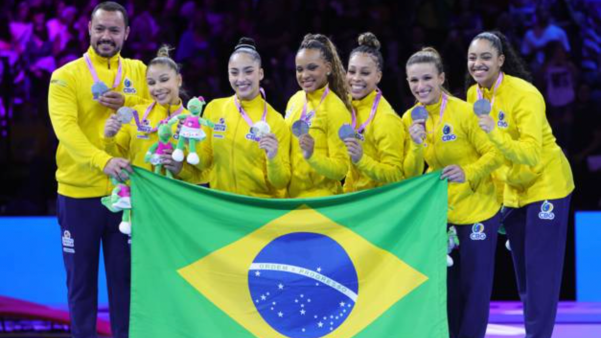
Team Brazil
A year after making history as the first program in history to win six straight world championships team titles, the United States continued to set themselves apart with yet another gold medal, making for the seventh in a row and the ninth overall after first winning in 2003.
Led by Simone Biles and Shilese Jones, both of whom competed all four events, the final wasn’t without drama as Joscelyn Roberson sustained an injury during vault warmups just minutes before the competition started. With Roberson out, the team was left with only four competitors, and Leanne Wong had to step in incredibly last-minute on vault, though she and the team handled the pressure brilliantly to get the win with a 167.729.
Biles and Jones had the top scores on every apparatus, with Biles putting up a 14.8 on vault and a 15.166 for the best floor routine she’s essentially ever done, while Jones had the team’s best score on bars with a 14.633. Skye Blakely competed only on bars, doing a good enough job to earn a 14.166, while Wong did a great job to put up a 14.066 on vault while also hitting her floor routine for a 13.166.
Unfortunately, there was a little bit of drama on beam as Wong, who was the leadoff for the rotation, had a fall on her side aerial for her first real miss out of the couple dozen routines she competed this season. Her 11.7 made things a bit nerve-wracking with two competitors still to follow, but Jones managed to bring things back into focus with a mostly strong routine aside from a big wobble on her acro series, earning a 13.6, while Biles wrapped things up with a just minor deductions to earn a 14.3, keeping the team in the lead by nearly two points going into the final rotation.
The rest of the competition brought massive levels of excitement, exactly the kind we love to see in a team final. Coming into world championships, I had Great Britain all but guaranteed a medal, with Brazil also pretty likely in my mind, and in qualifications, the British ladies proved me correct to land in second, though Brazil finished fourth behind China, a team with basically zero vault prowess but bars and beam rotations that beat every other team in the mix.
The British team has been incredibly consistent over the past couple of years, so I expected nothing but the best in the final, though they had a few shocking moments that took them out of the running completely, while China wasn’t able to bank on the same level of beam supremacy that they showed in prelims after counting a bizarre fall onto the apparatus. Instead, the Brazilians finally pulled through with the kind of meet we’ve wanted from them since the second Rebeca Andrade and Flavia Saraiva became seniors back in 2015, winning the silver medal just a little over two points behind the United States, while France – which finished seventh in qualifications – stunned to win the bronze, showing that truly any team in this final had the potential to finish on the podium.
The Brazilians saw brilliant performances from Andrade and Saraiva, both of whom competed close to their best on all four apparatuses to ensure a big result for the team, which also saw Olympic veterans Jade Barbosa and Lorrane Oliveira on one apparatus apiece – vault and bars, respectively – and the talented young Julia Soares on beam and floor.
There were mistakes here and there, but mostly minor ones, and it was clear that even though the team trailed in fourth place going into the final rotation, moving to vault would absolutely put them over the top, and that’s exactly what happened. Solid Yurchenko double fulls from Barbosa and Saraiva paved the way for a massive score from Andrade, who performed a gorgeous Cheng with a college stick into the salute for a 14.9 to secure the silver medal with a 165.530 team score, a history-making moment as these women became the first in the program to win a team medal at worlds, breaking the fourth-place record they set in 2022.
With a solid but not overly impressive start on floor followed by a strong vault performance, France ended up in third place after two rotations, though it really wasn’t clear that they’d land on the podium until the very end of the final. Finishing on bars and beam is tough for any team, and especially for one that showed mistakes and issues on both apparatuses in prelims. But the ladies proved that a bad dress rehearsal means a great opening night, as they managed to improve on their bars performance by several tenths, and then on their beam performance by nearly two full points, carrying the momentum through that entire electrifying rotation to earn a 164.064 for the bronze, the program’s first team medal since 1950 and the second in history.
Mélanie De Jesus Dos Santos was of course a hero for the team, competing all four events with scores of 14 or higher on three of them, and though Marine Boyer was at a lower level of difficulty, she was solid across all four of her own events, including putting up a 13.733 for a lovely beam set. Coline Devillard did what was expected of her on vault, with her handspring rudi earning a 14.3, and Lorette Charpy proved to be integral to the team’s success with a 14.133 on bars, but I was most impressed with Morgane Osyssek, who made her worlds debut at nearly 21 years old with a breakthrough performance that I truly did not expect. I didn’t expect her to make the team at all, thinking they’d take Djenna Laroui – who still picked up a medal as the alternate – for her bars, but Osyssek had one of the best routines of her career on beam and she was phenomenal on floor, and I truly don’t think this team would have reached the podium without her.
As I mentioned, China was unable to capitalize on a massive beam score and wasn’t able to make up the loss elsewhere with weaker vault and floor rotations, and with a fall counted for Zhang Qingying on her Yurchenko loop, the team finished nine tenths away from a medal. It was a massive heartbreak after seeing them do so well during qualifications, but regardless, I hope this young and largely inexperienced squad is proud of what they accomplished here after several years of team final implosions from more accomplished athletes.
They did much better than I expected on both vault – where the difficult was low but the athletes were solid – and floor, where Zhou Yaqin earned a pretty massive 13.833, and we saw some gorgeous performances on bars from Huang Zhuofan and Qiu Qiyuan, while Zhou and Ou Yushan did some lovely work on beam, where Zhang was also stunning despite the loop drama. They may not have medaled, but all of these ladies brought a style and artistry missing by so many teams, and I hope with more experience they can continue their rise.
Italy ended up in fifth with a 162.997. A medal wasn’t super likely for this team, which is dealing with injuries to three top competitors, though I was impressed with how well the replacements – the inconsistent Angela Andreoli, first-year senior Arianna Belardelli, and often-injured Elisa Iorio – looked in the final. Manila Esposito again showed that she’ll be practically a lock for Paris, competing on all four events with some of the best routines of the competition, though unfortunately Alice D’Amato – the reigning European bars champion who had only one miss on this apparatus out of 17 routines in the lead-up to worlds – had a miss on this apparatus just as she did in qualifications, which was one of the most devastating moments of the meet for me. Hopefully next year the program will pace her better and won’t have her competing this apparatus 17 times over the span of six months.
As for the British women, they ended up down in sixth place with a 161.864. Vault started with a pair of strong Yurchenko double fulls from Ruby Evans and Ondine Achampong, but in the most shocking moment of the meet, Jessica Gadirova missed the block on her Cheng and crashed the landing, leaving the team to climb out of a hole on an apparatus that should have been their rock.
She came back well with big hits on bars, beam, and floor, and Alice Kinsella also counted bars and floor hits while Achampong was excellent on beam and Evans put up a great set on floor, but Georgia-Mae Fenton fell on both bars and beam, and while this is an incredible team, it’s not a “medal with three falls” team, like pretty much every other team in this final. It was a bummer to see them fall short of expectations, but with so many teams being so close and so competitive, it only adds to the excitement of the final.
The Netherlands finished in seventh place, putting up a total of 159.563 with Eythora Thorsdottir leading the team on all four events. Overall, they did their best work on bars, with a 13.833 from Sanna Veerman and a 14.233 from Naomi Visser. Visser wasn’t at a hundred percent on beam or floor, and Sanne Wevers had a fall on her acro series on beam, so the team was a bit held back on what should be a top apparatus for them, but it was nice to see a strong performance from Vera van Pol, who put up the second-best scores on vault and floor, proving once again why the veteran continues to make team after team.
Finally, Japan was in eighth place with a 157.496, exactly where they were in qualifications, and based on how they looked there, it was clear they weren’t going to be quite the same team we saw when they almost medaled in Liverpool last year. Miyata Shoko has been dealing with an injury, and though she competed all four events here, she was a little lacking based on what her potential is, most notably on floor, though I think she still did a great job overall, especially in leading the team. Specialists Fukasawa Kokoro and Ashikawa Urara did well enough on bars and beam, respectively, while first-year senior Kishi Rina showed tons of promise with her performance, and Hatakeda Chiaki – who finally made her worlds debut here after originally being named the alternate, replacing the injured reigning beam champion Watanabe Hazuki – did well on bars and floor, but unfortunately sat her Yurchenko 1½ on vault.
Next up at world championships are the all-around finals, with the men competing later today while the women follow tomorrow.
Article by Lauren Hopkins
 The Gymternet