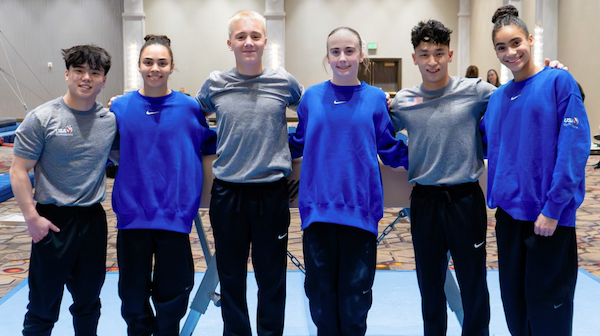
Asher Hong, Hezly Rivera, Danila Leykin, Claire Pease, Yul Moldauer, and Charleigh Bullock
The American Cup, which debuted as an international all-around competition in 1976 and later became part of the FIG’s world cup series, was one of the last events the gymnastics world saw in 2020 before Covid shut everything down.
Most meets returned within a year or so of the global shutdown, but the FIG all-around world cup series disappeared, and the American Cup along with it. A small competition that generally saw fewer than 10 competitors, the series was expensive to produce, and it was difficult to attract top-performing athletes who didn’t want to travel – halfway around the world in many cases – for a one-day event. The all-around series as we knew it is still in limbo, but USA Gymnastics announced last year that the American Cup would return in honor of its 50th anniversary this year, and with a brand-new mixed team format to help nations prepare for the introduction of a mixed team competition at the Olympic Games in 2028.
There are already a bunch of mixed team competitions held around the world, with the most popular being the Swiss Cup, the Sokol Grand Prix, and the DTB Pokal Mixed Cup. At the higher level, the European Youth Olympic Festival introduced a mixed team competition a few years ago, and the event was also added to European Championships last year, also in an effort to help athletes prepare for a similar format in Los Angeles.
Most of these follow a similar format, with all teams competing in the earliest round and facing elimination for the semifinals and finals. There are some nuances across each series, however, and I think the American Cup format is closest to what we typically see at the DTB Pokal.
The Competitors
A total of eight nations will compete at the American Cup, with each team fielding two or three athletes to contribute to the total.
| BRAZIL | |
| Vitaliy Guimaraes Diogo Paes Diogo Soares |
Gabriela Boucas Ana Luiza Lima Sophia Weisberg |
| CHINA | |
| Li Hongyan Xie Chenyi Zhang Yangyu |
Ke Qinqin Tian Zhuofan Zhang Qingying |
| GREAT BRITAIN | |
| Oakley Banks Sam Mostowfi Sol Scott |
Abigail Martin Emily Roper Ruby Stacey |
| JAPAN | |
| Hashimoto Daiki Tsunogai Tomoharu |
Kishi Rina Nakamura Haruka |
| MEXICO | |
| Rodrigo Gomez Isaac Nuñez Mario Rojas |
Natalia Escalera Mariangela Flores Paulina Guerra |
| PHILIPPINES | |
| Evan Aliwalas Zachary Nunez |
Chiara Andrew Llya Escoses Haylee Garcia |
| SPAIN | |
| Nicolau Mir Joel Plata |
Marina Escudero Alba Petisco |
| UNITED STATES | |
| Asher Hong Danila Leykin Yul Moldauer |
Charleigh Bullock Claire Pease Hezly Rivera |
How Does It Work?
The American Cup will include three rounds of competition, with two teams eliminated from each round and team scores not carrying over between rounds. Teams are choose between three MAG apparatuses – floor, parallel bars, and high bar – and three WAG events – uneven bars, beam, and floor – in each round, and athletes aren’t allowed to repeat an event.
In the preliminary round, all eight teams will put up two MAG and two WAG athletes each for a combined score of four routines per team. For this round, the start list was determined by a random draw. At the conclusion of this round, the six teams with the highest combined scores then move on to the semifinals.
The semifinal round will look the same as the first, with all six teams that have advanced again putting up two MAG and two WAG athletes apiece for a combined score of four routines per team, with the only difference being that the rotation order will be determined by how teams were ranked in round one. At the end of the semifinals, the four teams with the highest combined scores then move on to the third and final round.
In the finals, also known as the medal round, the remaining four teams will again put up two MAG and two WAG athletes apiece for a combined score of four routines per team, with the rotation order again determined by the previous round’s rankings, and the best three teams based on this round’s scores will finish on the podium.
How to Follow
The event begins at 6 pm local time (the competition is in Henderson, just outside of Las Vegas), with streaming on Peacock in the U.S. and an international stream on the USA Gymnastics YouTube channel, as well as live scores available here.
We’ll also be reporting live from the arena and will have a live blog up and running. You can also follow us on Twitter!
Article by Lauren Hopkins
 The Gymternet
hi sorry for the dumb question but what time zone is local? (As in where is the event, I can work out the time!) I can’t seem to find the city info anywhere!
LikeLike
Oh, sorry, I thought I said Las Vegas! I’ll add it if not, but anyway it’s PT!
LikeLike