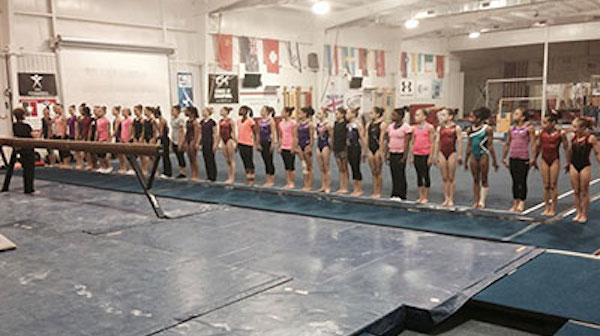
Although the success of a gymnastics program is a complex puzzle with many moving pieces, one highly important piece relates to the number of gymnasts enrolled in high-level programs in a given country.
The United States is filled with over a thousand level ten gymnasts, along with anywhere from 30-80 gymnasts training at the elite level at any given moment, according to statistics from USA Gymnastics. Meanwhile, former powerhouses Russia and Romania (and to a somewhat lesser degree, China) are struggling to keep enough gymnasts in their senior elite program to even furnish a competitive World Championships team.
In 2014, the U.S. also saw less gymnasts than usual at the top, with only 13 competing at the national championships, down from about 20 due to injuries, but Martha Karolyi and the World Championships selection committee didn’t have to worry about not being able to fill out the roster. The disparity between these top programs is clear, and begs the question of why there are simply so many gymnasts in the U.S. willing to train at such a high level.
The answer lies partially in the opportunities presented to gymnasts in the U.S. (and, to a lesser degree, other English-speaking western nations, like Great Britain, Canada, and Australia). Gymnasts in the United States simply have more opportunities to continue gymnastics beyond the elite level, and therefore parents and gymnasts alike are more motivated to stay in the sport through to high school.
The existence of college gymnastics has in turn spurred the expansion of the U.S. elite program because it means that parents no longer have to sacrifice their children’s education for their gymnastics career. Collegiate gymnastics became incorporated into the NCAA in 1982, and subsequently the presence of the United States has steadily grown in international competition. Then Mary Lou Retton won the all-around at the 1984 Olympic Games in Los Angeles, and the U.S. watched as their program began to rise on the world stage.
In the 2000s, it can be argued that the U.S. has become the dominant power, winning eight of the last ten world all-around titles, three team titles since 2007, and 12 Olympic Games and 35 World Championship medals since 2004. The elite program and the collegiate program have a mutually beneficial relationship, as the success of Olympic gymnastics in the primetime arena every four years has encouraged more kids to get involved in the sport, and gymnasts tend to stay in the sport longer in order to pursue college educations through athletic scholarships.
In 2009, there were 1684 level ten gymnasts and 79 gymnasts who had tested into the elite program. These numbers are well beyond the 20 or so gymnasts at the junior and senior levels that train at the national centers in Russia, Romania, and China. With more gymnasts staying in the sport at higher levels, those few who have the rare combination of talent, work ethic, coaching, and resources are more likely to pursue the elite path, knowing that should that path not work out, collegiate gymnastics is always in their future.
Essentially, gymnasts in the United States know that elite is not the be-all, end-all of their career. As they go after harder skills and longer hours, they know there will likely be a reward for their efforts, even if it’s not a coveted spot on the Olympic team. The majority see the college scholarship as an end goal that is more tangible and realistic than the Olympics, a way to pay back their years of support and effort.
For example, earlier this year 2012 Olympic alternate and multiple World Cup title-holder Elizabeth Price retired from elite, much to the surprise of fans. She cited her desire to go to college rather than pushing back her matriculation a full year in order to pursue a berth on this year’s World Championships team. For Price and other gymnasts – elite or not – collegiate gymnastics is reward enough for staying in the sport long-term, and it gives gymnasts the chance to not only continue competing, but also to develop as people, gain a college education, and go beyond simply living in the gym.
Conversely, when examining the sports machine that is the former Soviet Union, rewards for achievements in sports remain largely the same as they did 20-plus years ago. Though a tiny percentage of top-level gymnasts are given cars, apartments, and special perks for their success, parents know that the changes of becoming an Olympic or World champion are slim. Gymnasts who show promise are expected to move away from home, and their education is limited because of the sheer number of hours that they train. Although many are given the opportunity to attend university, it is often only part-time, as gymnastics takes precedence.
The end goal for a Russian, Romanian, or Chinese gymnast is to become a World or Olympic champion. Beyond that, there is no career for a gymnast beyond the age of 14 or 15 who is not already on the national team. With no gymnastics opportunities, limited education due to training, and the high likelihood of injury, parents have become reluctant to put their children in the sport. Why train at such a high level, they ask, only to become injured and have no viable skills beyond their sport? Many parents see it as limiting their children, rather than opening the world to them as it did during the communist era in Russia and Romania.
Chinese gymnasts are given the chance to attend state universities, but their limited education during their formative years has left them bar behind their classmates. In a recent interview with a Chinese newspaper, two-time Chinese Olympic champion Deng Linlin spoke of the struggles to keep up with her classmates at the Peking University’s School of International Studies. “I don’t even know the first thing about how to write a paper or book report,” she told the reporter. “I feel like my brain is swollen right now.”
Gymnasts in the university systems in countries with highly centralized national teams often struggle to keep up in the classroom, and some leave school out of frustration. Stories of homeless and destitute gymnasts, like Universiade MAG gymnast Zhang Shangwu, reveal the issues with machine-like programs that work to create world champions but do not consider the problems that can emerge from not creating well-rounded student athletes who are given the tools to succeed in life after retirement.
So why are the number of kids enrolled in sports programs in Russia, Romania, and China dropping, while enrollment numbers in the U.S. are rising? It’s because athletes in the U.S. have the opportunity to become well-rounded people who are not forced to sacrifice their education and future for a small chance at momentary glory. Parents see a college scholarship as reason enough to keep their children in the sport, and gymnasts are encouraged to keep working hard, even if elite goals don’t necessarily pan out.
Because there are so many high-level gymnasts who train in the United States, the qualification scores required to compete at nationals are very high, and yet about 50 junior and senior gymnasts were still able to obtain them. This is miles above the number of gymnasts in Russia, Romania, or China who could hit the same scores – in fact, I don’t think these three programs combined could produce 50 gymnasts that could obtain U.S. national qualification scores, showing the sheer depth in the U.S. program.
Though this year did see a drop in the number who competed at nationals, the reasons to stay motivated to continue in the sport through high school all but guarantees that there will never be a shortage of hard-working and talented young gymnasts working to qualify next year. The United States doesn’t need to worry about a decreasing talent pool anytime soon.
Article by Caitlyn Hynes
 The Gymternet
this website is truly a gem of the gymternet. great to see content like this. a lot of great insight on the value of the ncaa program which is something i normally don’t think about when thinking about elite gymnastics.
LikeLike
Thank you so much! I was so happy to have this article sent to us…it’s definitely something I’ve never thought about when discussing why the U.S. elite program is such a success…I think of developmental programs, the non-centralized system, but I never thought of the fact of having another really valuable prize aside from one of five Olympic team spots to strive for is why there are so many top-level girls. Even if top L10s never transition to elite, they could probably succeed internationally as elites with very little alterations…I remember Charity Jones (now at Oklahoma) competed at the Nadia Comaneci meet one year (which used elite scoring) and had a pretty decent AA score despite never having done elite! A large number of L10s could seamlessly transition over and if it doesn’t work out, college is always the perfect option. A very smart way to look at it!
LikeLike
I don´t really think that it is as simple as that. With Romania you can’t even start to compare the amount of children enrolled in gymnastics, estimated population of Romania is around 20 million an of US it is over 300 million. You do the math here.. United States as a country are also doing quite alright with their economy right now, if you compare it to any of those three: Russia, China or Romania. It is pretty hard to keep up with US as long as there is no proper funding.
LikeLiked by 1 person
It’s not that simple, but the article was about why gymnasts stay in the sport longer – and the answer was because the Olympics aren’t the only goal. If the question asked why aren’t other programs as successful, of course population and funding play a major role.
LikeLike
Alexander Alexandrov tried to implement something similar in Russia to help create depth and to increase retention of former gymnasts staying in the sport to coach (mentioned in an interview with Rewriting Russian Gymnastics, link below). He wanted to lower the requirements to achieve Master of Sport status for gymnasts not on the National team. Masters of Sport are ensured entrance to good colleges and universities, and they are allowed to become coaches after graduation. He wanted a similar system of rewarding level 9 and 10 gymnasts with education as the US has with the NCAA model. And also to allow top-level non-elites a career path for coaching because many great coaches were never elite gymnasts. Clearly, he came to the same conclusions as to why the US is strong when other countries are struggling with depth. Hopefully, other nations will start to implement their own versions of this type of system.
This part of the interview is near the end of the entry:
http://rewritingrussiangymnastics.blogspot.com/2013/08/alexander-alexandrov-in-his-own-words-4_30.html
The interview says that the changes for Master of Sport status were passed, but I seem to remember that Andrei Rodionenko later reversed this decision in favor of the original elite criteria. I’m not sure if I’m remembering correctly or not, hopefully someone else can confirm whether or not that’s right.
LikeLike
This is my new favorite gymnastics site. Thanks for posting such insightful articles!
LikeLike
Thank you so much!
LikeLike
The thing is that such a small amount of girls really get gymnastics scholarships, (especially full rides) but so many think they will, even when they have virtually no chance. The US elites are taking up a lot of them, as are the international elites. The top level 10’s are taking up a large percentage of them and at the young age some of these kids are committing (8th grade!!), the outlook for your decent level 10 is not what it once was and that is becoming disheartening to many!!
LikeLike
Agree with tiredmaof4. I read an article recently by a coach and the misconceptions that parents tend to have when they enrol their child in a gym class. One of which is that if their kid is talented then they will get a collage scholarship actually it’s really competitive and hard to come by them. Not as hard as an Olympic spot but still tough!
LikeLiked by 1 person
Pingback: News Article: Olympic Dreams Aren’t for Everyone
Pingback: The NCAA Gymnastics Championship Won't Belong To The Olympians | Beautycribtv.xyz
Pingback: The NCAA Gymnastics Championship Won’t Belong To The Olympians – News Feed Center | The Internet At A Glance
Pingback: depth of USA Gymnastics | | Sports News and Entertainment!