It’s time for the 33rd edition of You Asked, The Gymternet Answered! We apologize if we haven’t gotten to your question yet, but we try to answer in the order in which they were received. Something you want to know? Ask us anonymously by going through the contact form at the bottom of the page!
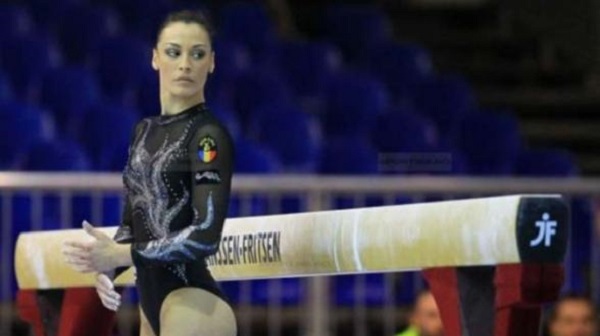
In the 2004 Olympic beam final, Catalina Ponor performed an Omelianchik. She ended in a handstand but before she lowered down to the beam she adjusted one of her hands. Is this a deduction? If it is, was Ponor deducted for it?
Yes, this would be a deduction because it shows a form break in the skill. However, it’s impossible whether to know if she received a deduction because itemized lists of deductions are not provided by the judges.
Where can one watch past NCAA meets for the season without cable information?
Your best bet is YouTube. Even when full meets aren’t available, many teams have YouTube channels and will share routines from their performances. Just search the team you’re interested in watching, and then sort by “most recent” because then you’ll see their most recent uploads. Occasionally, gym fans will upload full broadcasts of various meets, so you could get lucky and find the occasional pot of gold!
I’ve heard that one of the reasons the Russian and Chinese do not show up to compete at the American Cup is difficulty and issues getting US visas at short notice. Have you heard this and are there special visas that athletes get to compete in the US?
I’m not sure about special visas for athletes, though I doubt that specifically exists…I know it’s possible to expedite visas but it’s definitely a challenge and just might not be worth the hassle just to send a gymnast for a one-day meet, especially knowing what Yao Jinnan went through to get a visa for surgery/treatment in the U.S.
I see that you are starting MAG stuff, which I know nothing about. I see that the mens team are on average a lot older than the women? Why is this? Is it because to qualify as a senior men have to be older?
It has less to do with qualification age and more to do with peak age. Women grow faster than men, and thus tend to peak at younger ages, which is why the most successful gymnasts in the world tend to be somewhere in the range of 16-18 (though obviously this trend is changing as many older gymnasts are training into their 20s and beyond). For men, 18 is usually the age where they are pretty much done growing, and then from there they can work on building muscle and consistency with skills. A 16-year-old MAG competitor just wouldn’t have the same advantages as an older gymnast because he’s typically at a physical disadvantage, whereas a 16-year-old WAG competitor is pretty much already done growing. This is a simple explanation…a lot more goes into it, and obviously age isn’t a magic number for physical maturity, especially as there are some women who grow into adulthood around 14 and others who are still tiny and undeveloped at 17, but for the most part, this is how things work.
What happened to London Phillips?
I think she just kind of fizzled out? She stopped doing elite in 2005 and then went on to win the level 10 vault title in addition to all-around bronze at J.O. Nationals in 2006. She had a full ride to Cal State Fullerton and was set to begin competing with them in 2007 but when their program died, she didn’t transfer. A shame…she was a super strong tumbler and it’s too bad we didn’t get to see more of her!
How do teams get invited to the Training Camps? Do athletes have to pay for their own travel and camp expenses?
National team members as well as those who are on the periphery (i.e. finished well at nationals but not quite well enough to earn a spot though could still be useful internationally or shows promise for the future) are invited to the ranch. Travel and expenses are funded for national team members. For the developmental camps, the athletes have to pay for their own travel and expenses.
Why can’t the Chinese produce floor routines with more difficult tumbling passes? Is it technique or strength?
I think it’s a combination of both, though leans more toward the technique side of things. There are definitely tiny girls who can tumble really well…look at Laney Madsen. She’s a good example because she’s new to artistic gymnastics and comes from a background in tumbling…so because she grew up and spent years focusing on almost nothing but tumbling, she’s really powerful and has huge passes even though she’s one of the tiniest U.S. gymnasts working at the elite level. And China’s Wang Yan is tiny, but she’s a much better vaulter/floor worker than she is at bars. The Chinese seem to aim most of their conditioning at producing strong bar workers, so I’m going to say that if they put half of that focus into floor, they’d have some really awesome talent there!
Having seen your answer to someone’s question about the difference in team sizes from world’s to the Olympics I have a question in that same vein, why did the 1996 team have seven members? There has never been such a large team before or since.
No matter the size of the team, it all comes down to two things…how many spots the sport is awarded by the International Olympic Committee, and then how the FIG decides to allocate those spots within the sport. I don’t know for sure about 1996 specifically, but because there had never been a team of seven in the past, it’s possible the FIG was like “hey, let’s try it out and see how it goes” but then decided in the next quad that it took away too many spots from individuals not on teams and thought taking away one spot on each team would open up more spots for other nations. Or maybe they just thought seven athletes per team made things far too easy because you could basically have a specialist for each event? But either way, it all comes down to the spots available and how the FIG decides to allocate them. Now of course there’s the proposed 2020 decrease in team size, which we’ll talk about in a coming article, but it’s basically the FIG working with the limited number of spots they’re given and trying to make the sport as inclusive as possible.
I’d like to know your opinions on Texas Dreams’ current elites (Nica, Peyton, Ragan, Bailie, and Grace). It seems they’ve had lots of trouble with various injuries lately–where do you see them fitting in next year?
Well, Bailie is obviously going places, and should be one of the top seniors in the country this year with Worlds well within her reach. I think this will be the year where Peyton and Nica try to see if they can be a part of the sport on a high level to determine whether it’s more worth it to either keep training with the hopes of going all the way in 2016 or just settle down and prepare for NCAA. Ragan and Grace are still juniors, so they have time and don’t have to worry about choosing between elite and NCAA for 2016, and I think both will attempt to make runs for the Olympics. Ragan is on a really great path, especially on beam and floor, which were both problem events for the U.S. this year. Grace is a bit harder to pinpoint, because she didn’t really show much last summer, and was just so young in 2013, we didn’t get a good picture of what she can do.
The more pressing question for me on Mustafina’s floor is why she did two triple Y spins in all of last years Worlds routines and got credit for both each time? What happened to skills only being counted once?
Do we know she got credited for both? I don’t go through every routine and add up difficulty so I don’t even know if what you’re saying is accurate, first of all. Second, I only remember one routine where she did it twice, and I think the reasoning for that was because she fell out of the first one (or didn’t complete it to the point where she’d receive credit) so she did a second one later on in order to receive credit. I don’t remember her other routines, though, and thought she did a triple Y and then just a single or double for the others? But yes, my guess is that if she did two, it was in case there was a mistake in the first, and that she was only actually credited for one. Anyone have any other information that can elaborate?
With the three-up three-count system in a team final, what would a team do if one of their gymnasts is injured? Are they allowed to put up another gymnast or must they count the score of the injured gymnast?
If they’re injured during a routine they’re performing in the team final and can’t finish the routine, the team must unfortunately count that score. If the injury comes during warm-ups, they can just shift the lineups around a bit and put someone in the injured gymnast’s place, but I believe the rule is that if they start the routine and are injured midway, they can’t put a replacement in at that point.
Want a question answered? Ask us using the contact form below! Just want to comment? Keep scrolling for the comment box…the contact box below is for questions only! Keep in mind, we receive a lot of questions and at any given time are about two months behind in answering. If you want to know the time or location of an upcoming competition, Google is your friend!


Article by Lauren Hopkins


Regarding Mustafina’s Y spins –
She included a Mustafina (triple) and a Memmel (double) in her routine. In the most ideal situation, she does the triple after he first pass and then the double after her second pass. But in the case where she obviously doesn’t complete the triple on the first try, she would try again on the second.
I think for most people the 2014 World Championship EF routine was the most confusing. She fell out of the first attempt, so she gave it another shot after the second pass and completed it. It’s confusing since a lot of commentators claimed that Mustafina did the triple Y spin twice, when she actually did a double Y spin and a single spin with leg well under horizontal on the first try, and a triple Y spin on the second try.
Her ideal dance elements in order –
Triple Y Spin (E), Quad Spin (E), Double Y Spin (D), Split Leap (A), Switch Leap 1/2 (C)
The dance elements credited during 2014 EF in order –
Double Y Spin (D), Quad Spin (E), Triple Y Spin (E), Switch Ring Leap (C), Switch Leap 1/2 (C)
She most likely replaced her split leap with a switch ring leap at the end, just in case the judges gave her credit for the triple Y spin twice. I personally think it’s a very clever back-up plan.
Hope this helps!
LikeLike
Hmm, I didn’t know if you do the same element twice you can ever get credit for it twice. I mean I guess that goes along with if you can do a mustafina you should be able to do a memmel easily. I always thought that you can only get credit once for an element no matter how many times you repeat it. And also that you can only get credit for the higher of the two similar skills, i.e. only get credit for a mustafina but not a memmel as they are similar skill. What’s to prevent anyone from just doing 4 mustafina?
LikeLike
She wouldn’t actually get skill value for it twice. She upped the difficulty on the leap (A to C) to gain .2, in case they considered the turn the same skill both times (in which case she’d only get the value for the first one).
LikeLike
If she does the same element twice, she will only get difficult value for the first one. But in this case, she gets difficult value for both the Memmel (D) and the Mustafina (E). They are listed in the COP as different skills with different difficulty rating. Simone does a double twisting double tuck and a full twisting double tuck. They are similar skills. But since they are listed as different skills, she gets difficulty values for both. And like Aerial says, Mustafina would only get difficulty value for the same spin once if the judges thought they were both the Memmel or both the Mustafina.
I think what you’re thinking about is a completely different case where two similar skills are listed and considered the same skill in the COP. For instance on bars, an Ono (full pirouette on one arm start from El-grip and end on reverse grip) and a Ling (full pirouette on one arm start from El-grip and end on El-grip) are considered and listed as the same skill, even though the actual action of doing them are slightly different. If a gymnast does an Ono and then a Ling, she will only get difficulty value for the Ono. Similarly, on floor, a full-in, a full-out and a half-in-half-out are all listed as the same skill. So though the technique is different, you can only get difficulty value once.
Hope I didn’t make it even more confusing!
LikeLike
I kinda see the reason how you can get credit for both a mustafina and memmel. I was just thinking along the line of DTY and amanar that a vaulter won’t get counted for both. So I was thinking along the line of mustafina and memmel being sort of in the same “family” of twisting.
I guess a mustafina is always tricky as mustafina herself doesn’t always do one consistently… It’s interesting that laney madsen already showed that she’s capable of a quad Y spin, but didn’t incorporate that into her fx routine yet. The leg position for the Y turn appears to be a position that she’s completely used to as seen in her stunting videos. Guess will have to wait to see more of her UB BB, but definitely got the all the raw talents to be a great FX worker….
LikeLike
You’re confusing vault and floor, though. The ‘same family’ rules only apply on vault. ‘Family’ essentially applies to the entry onto the vault (whether it’s a forward entry or backward entry onto the table) and nothing else – not how many twists, not how many flips, etc. While you can’t do the same exact element on floor, there is no such ‘family’ rule that exists for tumbling or dance elements, otherwise they’d be pretty limited in what they could do. The closest that a ‘family’ rule plays in is like, how they have to have at least one forward/sideways directional pass in their tumbling? But otherwise, just like a back layout double is different from a back layout triple on floor, a double spin is different from a triple spin. No family rule involved at all.
LikeLike
Thank you! This is exactly what I thought happened, but wasn’t 100% sure – I hadn’t watched any of the Worlds routines since they happened and didn’t have time to rewatch before posting, but that made the most sense to me and is what I remembered from her routines.
LikeLike
Proposal to decrease team size for 2020 definitely hurts everyone. We will less likely to see outstanding specialists like maroney or locklear. It would also narrow the depth advantage enjoyed by US… but marta has already prepared for this by emphasizing everyone trying to do aa or train in as many events as they can so US would still be in good shape even if score gap narrow a bit
LikeLike
Nastiafan101 posts all of the NCAA meets on gym multimedia. Here is the direct link to the 2015 meet page: http://gymmultimedia.myfastforum.org/forum25.php
Nastiafan also posts some individual routines to their youtube channel.
LikeLike
It’s smart to have a back up plan in place since the triple y spin is so tricky. Same with ferrari on beam I’ve noticed at times she does sheep jump, ring leap, switch ring, and a switch half. I was confused at first but then realized she was making sure she had a back up in case she didn’t get full credit.
LikeLike
Regarding visas- there are visas specifically for athletes to come to the US and compete that are different from, say a tourist visa. They’re called P visas. The requirements are that “You must be coming to the United States to participate in team events and must have achieved significant international recognition in the sport. The event in which your team is participating must be distinguished and require the participation of athletic teams of international recognition.” The turnaround time is REALLY FAST as far as immigration is concerned- about 2 weeks for approval with USCIS (the agency within the United States). The issue is that once the petition is approved, you have to wait for the file to be sent to the US Consulate abroad (takes about a month), and then have to go for an interview/pick up the actual visa. All-in-all you “could” in theory complete the entire process in 2 months, although 2.5 months is a safer bet. Yao would have come on a different visa with different requirements, etc. so you can’t really compare the two. So is it worth it for Russia/China to jump through those hoops? Maybe not, but I doubt short notice is the real justification here.
LikeLike