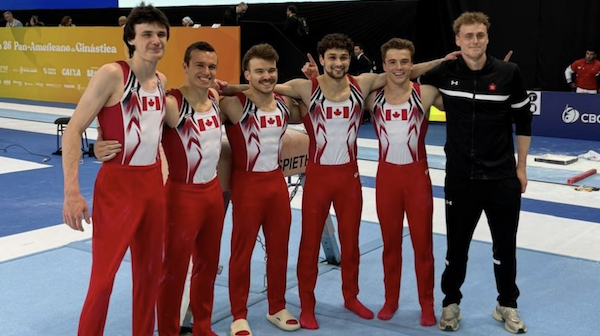
The first day of action at this year’s Pan American Championships in Rio de Janeiro, Brazil determined the winners of the team competition along with both the teams and individual athletes that will qualify to this year’s world championships.
In the women’s competition, the U.S. faced some adversity early on after Olympic gold medalist Hezly Rivera faced some pain, downgrading her vault to a Yurchenko full before withdrawing from the competition. The team was already missing newcomer Lila Richardson, who had a bars injury during training, and Alessia Rosa – also in her international debut – was tapped to step up in her place in the roster on beam. But with Rivera out, Rosa also had to cover bars and floor, while Simone Rose was added to the beam rotation.
Despite the drama, the team made it through with relatively solid results across the board, led by first-year senior Charleigh Bullock, who had the top all-around score of the day with a 54.165, Claire Pease, who followed closely behind with a 53.932, and Rose, who contributed strong scores on vault, bars, and beam to earn a 53.198.
In the end, the U.S. was able to pull out a 161.628, winning the gold medal nearly four points ahead of the rest of the field, while Brazil earned the silver with a 157.796 and Canada earned the bronze with a 156.997.
These three teams along with Argentina (fourth with a 154.397) and Mexico (fifth with a 151.096) also qualified team spots to this year’s world championships, while 13 athletes not part of these nations qualified as all-arounders, including Ana Gabriela Gutierrez and Hillary Heron of Panama (their young but powerful program was less than a point back from defeating Mexico!), Samantha Marin of Costa Rica, Jahzara Ranger of Jamaica, Alais Perea and Ashley Bohorquez of Ecuador, Sophia Diaz of the Dominican Republic, Ginna Escobar of Colombia, Karelys Diaz of Puerto Rico, Fabiola Diaz of Peru, Keyla Leyva of Cuba, Luana Roda of Peru, and Paula Carvajal of Chile.
See the full list of WAG qualifiers to worlds at our tracker.
Wednesday’s competition also served as the qualification round for the individual finals in Rio.
Behind Bullock and Pease, the top all-around contenders include Thais Fidelis of Brazil, who was fourth with a 52.965; Lia Redick of Canada fifth with a 52.932; Michelle Pineda of Mexico, sixth with a 52.399; Isabella Ajalla of Argentina, seventh with a 51.633; and Sophia Weisberg of Brazil, eighth with a 51.399.
Leading the apparatus qualifications are Rebeca Andrade on vault (her Yurchenko double full and Lopez combination in her first competition since 2024 scored a 14.549, more than half a point ahead of the rest of the competition), Fidelis on beam (she had a 13.833 there), and Pease on bars and floor (her scores were 14.1 and 13.4, respectively).
The men’s competition saw a fantastic upset from a stellar Canadian team, which earned a 243.026 thanks to especially strong performances from René Cournoyer and Félix Dolci along with a stunning pommel horse set from specialist Jordan Carroll.
Also surprising was the Colombian team – made up entirely of teenagers! – finishing with a 241.594 for the silver medal. Actually, seeing them finish on the podium was not a surprise, but the way they were able to soar past the much more experienced U.S. team, which included Olympian Yul Moldauer alongside worlds competitors Patrick Hoopes and Kameron Nelson.
Unfortunately, a number of falls from Nelson on high bar – an apparatus where the U.S. fielded only three athletes – meant the team would have to count a 9.833 in addition to an 11.9 from Riley Loos on pommels, though I think even with a stronger performance from the U.S., the Colombian team still may have prevailed thanks to star Angel Barajas doing his best across all six events to lead the all-around with an 83.065, a full three points more than Moldauer in second. Camilo Vera in his senior debut season was also excellent here, contributing scores on five apparatuses and currently sitting fourth in the all-around standings.
The U.S. men scored a 235.961 to come away with bronze despite the mistakes, finishing a point higher than the Brazilian team – led by Diogo Soares who put up strong routines across the board – with a 234.927 for fourth place.
With four team berths available to the men at world championships, it was Canada, Colombia, the United States, and Brazil who made it through, while the six all-around berths went to Diorges Escobar of Cuba, Santiago Mayol of Argentina, Jose Lopez of Puerto Rico, Isaac Nuñez of Mexico, Elel Wahrmann-Baker of Jamaica, and Jensuel Soto of Puerto Rico.
See the full list of MAG qualifiers to worlds at our tracker.
In the junior competition on Thursday, the U.S. women were again dominant, with all four athletes finishing at the top of the all-around rankings to win the team title with a 153.264, ahead of Canada with silver and Brazil with bronze. The all-around podium was limited to two athletes per country, with Amia Pugh Banks earning a 51.066 for gold while Vivi Crain got the silver medal with a 50.965, and stepping up for the bronze was Taya Macey of Canada with a 49.366.
The team podium on the men’s side was identical, with the U.S. juniors earning a 224.394 for gold while Canada and Brazil again won silver and bronze, respectively. In the all-around competition, Thomas Tittley of Canada won gold with a 75.498 ahead of teammate Jaydon de Silva with a 74.765 for silver, while Benjamin Fernandez of Argentina won bronze with a 74.432.
The competition continues tomorrow with the senior women’s all-around final at 9 am local time followed by the men at 3 pm. The juniors will return on Saturday with apparatus finals beginning at 9:30 am, while the senior apparatus finals take place on Sunday at the same time.
Complete results are available here for the seniors and here for the juniors. For more information about Pan Ams, check out our coverage guide.
Article by Lauren Hopkins

